
“We passed accelerated stability. Can we print a two-year shelf life?”
That question usually shows up early—sometimes before the commercial bottle has been chosen. We open the study file rather than answer from the cover page. Which formula went into the chamber? Which shell? Which bottle or blister? The answer also has to name the condition, pull dates, method, and limits. Until those pieces line up, “passed” is only a headline.
In practice, we use the accelerated arm to look for trouble early and the real-time arm to document what elapsed time actually did. A dietary supplement stability testing plan can run them side by side, with a separate conclusion for each.
Open 21 CFR Part 111 first for a U.S. supplement. The GMP text covers specifications, packaging controls, and appropriate scientifically valid methods—not a universal chamber schedule. That missing schedule is intentional work for the formula and pack team.
1. Give Each Study One Clear Job
Accelerated study: store the finished product under a defined stress, then look for early movement.
Real-time study: store it at the proposed long-term condition and test on the actual calendar.
The first helps development decisions. The second is the observed long-term record. Many projects start the two tracks together; otherwise, waiting for the accelerated track can unnecessarily delay the real-time clock.
Questions for Accelerated Work
- shell condition: which option softens or becomes brittle first;
- pack comparison: moisture movement with and without desiccant;
- early signal: appearance, odor, assay, or disintegration;
- Which formula or package deserves the next development round?
- Is there an early warning that could stop an unsuitable commercial order?
Questions for Real-Time Work
- Did the exact formula and package remain within specification at each completed point?
- What direction did each result move?
- Is a result still compliant but approaching its limit?
- agreement—or disagreement—with the stressed samples;
- elapsed months in the record versus months that remain a projection.
There is an obvious gap here: a chamber is controlled, while trucks, warehouses, and kitchen cupboards are not.
The FDA’s Q1A(R2) stability guidance is often on the table when teams discuss conditions, pull frequency, significant change, or data review. We borrow from it carefully: the document was written for drug substances and drug products. Its science can inform a supplement plan, but its tables do not become supplement rules by citation.
2. An Accelerated Pass Has Boundaries
Accelerated testing can be extremely useful before production. It compresses the wait for warning signs. That makes it practical for controlled comparisons.
Possible comparisons:
- gelatin versus a selected vegetable shell;
- bottle A versus bottle B;
- liner or seal alternatives;
- desiccant versus no desiccant;
- two excipient systems;
- the current formula versus one controlled revision.
Hold the other variables steady. Change the formula, shell, pack, and batch at the same time and any difference becomes difficult to assign.
An accelerated result may also contribute to an initial shelf-life rationale. The wording “contribute to” matters. The team needs a reasoned link among the stress condition, known or observed changes, analytical method, package, and continuing real-time program. A short accelerated run is not automatically equal to a fixed number of months on a warehouse shelf.
Hekona’s finished-product assurance program lists accelerated stability work along with physical checks such as disintegration and blend uniformity. A buyer still needs the project detail:
- sample and batch identity;
- formula and capsule shell;
- exact commercial or trial package;
- storage conditions and time points;
- tests and methods;
- acceptance criteria;
- report and investigation responsibility.
Claims the Study Cannot Make Alone
Do not use an accelerated pass to claim that:
- every future lot will behave identically;
- any bottle, cap, blister, or desiccant will give the same protection;
- all shipping excursions are harmless;
- an opened bottle can be kept anywhere;
- one tested marker proves every label claim remains unchanged;
- a stress failure predicts the exact date of failure in normal storage.
Here is the awkward part about stressing a sample: the stress may change the route of deterioration. Heat and humidity can push a shell, coating, flavor, or packaging component in a direction that ordinary storage would not. That observation stays in the file together with the condition that caused it.
An acceptable report therefore sounds specific: “This version remained within these criteria through the completed accelerated points, while real-time testing continues.” It should not sound like a guarantee for versions and months that were never observed.
3. Let Real-Time Data Confirm or Correct the Early View
Real-time testing is slow because the clock is real. That is also its value.
At each pull, look past the green pass box. Keep the number, method, and direction. An assay may still pass while drifting down. Moisture may rise before the capsule looks different. Disintegration may lengthen without reaching its limit. Any of those patterns can justify another pull, a pack review, or a more cautious commercial decision.
Useful trend review:
- baseline compared with every later point;
- result plotted against time;
- chamber history and any excursion;
- package condition at the pull;
- appearance, odor, shell condition, and physical tests;
- assay or marker results;
- related changes, such as moisture moving with disintegration.
When later points head away from the accelerated pattern, reopen the shelf-life discussion. The long-term observations now deserve more weight; the disagreement is precisely the sort of information the second arm was meant to collect.
The conclusion travels with the chamber sample. After a source, formula, shell, bottle, count, closure, or desiccant change, put the old and new versions next to each other. Change control then records the route chosen: existing data, a justified bridge, or a fresh study.
4. The Chamber Sample Is More Than an Ingredient List
An ingredient list is not the stability sample. The fill, shell, and container-closure system travel together.
Freeze the Sample Identity
Before the first sample enters a chamber, record:
- formula and revision number;
- source or grade of key raw materials;
- target fill weight and capsule size;
- shell material, color, and supplier where relevant;
- batch number and manufacturing date;
- bottle or blister material;
- cap, liner, seal, and desiccant;
- capsule count and secondary pack.
Loose capsules in a laboratory bag may answer a development question. They do not directly support a marketed bottle unless the relationship is justified.
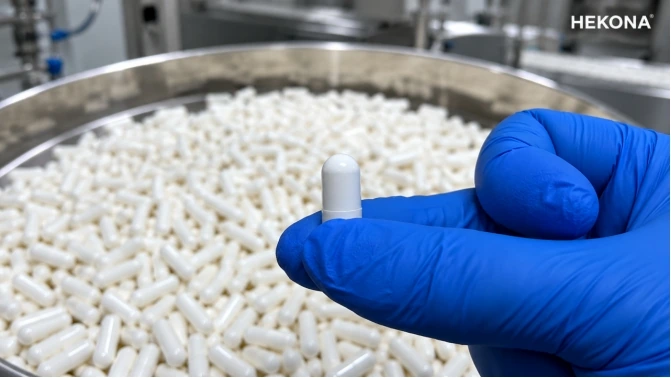
Hekona’s capsule manufacturing process includes material checks, blending or granulation where needed, filling, metal detection, packing, and finished testing. A stability sample should represent the version produced by that route. A repeatedly altered, unlabeled prototype does not.
Select Tests That Can Answer the Question
Possible attributes include:
- appearance, odor, and capsule integrity;
- brittleness, softening, leakage, or lock condition;
- moisture or water activity where relevant;
- disintegration;
- assay of selected actives or markers;
- relevant degradation or physical indicators;
- microbiological attributes selected from the product risk assessment;
- package seal or other package checks.
Do not copy every test into every pull. Some may sit at baseline and the final point, some at every pull, and some behind an investigation trigger. Cost belongs in the design conversation, but cutting the very attribute most likely to limit the product would defeat the study.
Method suitability belongs near the beginning. An assay that looks clean on the neat ingredient may stumble once botanicals, minerals, pigment, and excipients surround the analyte. Discovering that at the final pull leaves the team with almost no room to respond. Hekona’s laboratory testing capabilities cover active analysis, physicochemical work, microbiology, heavy metals, particle size, and capsule-related physical tests. The protocol must still identify the in-house or qualified external method selected for this product.
A Package Change Means a Different Sample
Between the capsule and the room sit the resin or blister, headspace, cap, liner, induction seal, and sometimes desiccant. Change that path and moisture or oxygen exposure may change with it. More than one pack size can mean more than one data set. “The capsules are the same” is not enough on its own to justify bracketing.
Hekona’s Magnesium Bisglycinate 200 mg Capsules give a useful configuration example: the page shows 200 mg elemental magnesium per two-capsule serving and 120 vegetable capsules in the bottle. A hypothetical 60-count, one-capsule version would not be the same physical sample. Fill load, shell use, count, headspace, and the bottle environment would all have moved.
5. Read Past the Report Cover
Approve limits and investigation rules before results arrive. That prevents an inconvenient number from shifting the target after the fact.
For every pull, the review file needs:
- sample identification;
- storage condition and chamber record;
- planned and actual pull date;
- methods and raw results;
- calculations and specification comparison;
- package and appearance observations;
- deviations, repeats, and investigation references;
- approved conclusion for that time point.
Do not delete a valid unfavorable result. Do not average it away. A repeat test can investigate a documented laboratory problem; it is not a routine replacement for a result that the team dislikes.
Also notice results that remain in specification but break the expected trend. Check sample identity, chamber history, preparation, instrument performance, calculations, and production records. Then document the reason for any follow-up.
Hekona’s recent guide to capsule sample checks before production makes version control, packaging, and the finished-product test plan part of sample approval. Carry the same version discipline into stability. The chamber should not be full of samples that no longer match the product going to market.
Approval Checklist
Before commercial production, close these items:
- Exact formula, raw-material versions, fill weight, shell, and package.
- Target markets and proposed storage statement.
- Accelerated and real-time conditions.
- Pull points and sample quantity, including investigation reserve.
- Named tests, methods, and pre-approved acceptance criteria.
- Identity of every batch placed into the program.
- Use of early accelerated data while real-time points accumulate.
- Reporting, investigation, change-control, and retention ownership.
Approve the protocol before chamber entry. Rebuilding it after the first result weakens the record.
Conclusion
Accelerated work gives an earlier view of risk. Real-time work supplies the direct record for the actual storage period completed. Use the first to screen, compare, and support a carefully limited early decision. Use the second to confirm or correct that decision.
The strength of the conclusion comes from the details: one controlled formula, one known shell, one recorded package, stated conditions, suitable methods, and pre-approved limits. “Passed stability” without that dietary supplement stability testing file says very little.
FAQ
Can accelerated testing set a capsule shelf life by itself?
It may be one part of an initial rationale, provided the design and interpretation support that use. Meanwhile, keep the real-time samples aging and label the record honestly: months observed versus months not yet reached.
What does each study look like in day-to-day work?
Accelerated work applies defined stress to show change sooner. Real-time work follows the product at the intended long-term condition as calendar time passes.
Must capsules be tested in the final package?
Use the proposed commercial package when the study is expected to support that package. Loose capsules or a different bottle may answer development questions but may not represent the marketed configuration.
How should the protocol’s test list be chosen?
Start from the formula’s risks. One question may be answered with appearance, shell condition, moisture, and disintegration. Another may also need a selected assay, microbiology, or a package check. The list is useful only when it matches the sample and decision.
Can existing data cover a new shell or bottle?
Not automatically. Review the impact through change control. A bridge may be justified, or a new study may be needed.
What if a result passes but is moving toward the limit?
A red box is not the first moment to act. If a compliant number keeps moving the same way at every pull, consider an extra point, a package review, an investigation, or a shorter claim.
Is Q1A(R2) the rulebook for this supplement study?
No. It is drug guidance. Its stability concepts can inform technical thinking, but the supplement protocol still needs its own product and regulatory rationale.