The CFU count of a probiotic label might say 20 billion, or it might say 50 billion pro-2–100 billon CFUs. The number is easy to print. A more challenging one is if the final product still holds up to that number when a consumer goes beyond said shelf life. The more challenging question is whether when the consumer gets to the end of that stated shelf life, wastage that number in finished product still supports.
This changes the development brief for a brand owner. Your probiotic project should not start with, “How much culture do we add?” It is should start with a defined strain set, a desired CFU time point, realistic shelf-life target (ideally the commercial capsule and package), along with stability plan. The start of a probiotic project should never be reduced down to “How much culture do we add?” It should include a defined strain set, master-timed CFU time point, realistic shelf-life target (out of the scope), commercial capsule and package-types intended for use-needs testing every six months-plus a stability plan.
Probiotics are living microorganisms. Viability can change during raw-material storage, dispensing, blending, capsule filling, packing, distribution, and long-term storage. A strong initial count is useful, but it is only the starting point.

1. Define the CFU Claim by Time Point
The same “20 billion CFU” statement can describe two very different product specifications:
- 20 billion CFU at or near manufacture/release.
- A minimum of 20 billion CFU at the proposed end of shelf life.
The second target requires a broader technicalfile, as it needs to take the eventual loss of viability into account over time in an actual commercial configuration. Guidelines for probiotic product quality stipulate that sufficient viability must be maintained throughout the production process and through storage in order to ensure that at least as many viable cells are present at expiration as indicated on the label. Quality probiotic product reviews stresses that manufacturers should ensure enough stability throughout production and distribution to guarantee the labeled count of viable cells through expiry
For technical background, see this review of commercial probiotic quality and stability.
An assertion of fact “at time of manufacture” will be understandable if that is the basis for its claim. But this should not be construed as confirmation that the same count will stick close to expiration. If the commercial aim is end-of-shelf-life potency, then formulation and stability program must be designed around that goal.
As an example of a specific Hekona probiotic product available now, Digestive Balance & Flora Support Formula. Key Takeaways for a New Project: Define the CFU time point prior to quotation, sampling, artwork and shelf-life planning. For a new exercise, the first key take-away message is to determine what time-point in CFU should be used before quotation and sampling/artwork/shelf-life determinations.
2. Start With the Strain, Not Just the Total CFU Number
A manufacturing brief for us is not simply “20 billion probiotics”. 5 Distinct Strains Respond Very Differently to Environmental Conditions – And ProcessingDifferent strains respond in very different ways depending on temperature, moisture and oxygen levels as well as processing conditions and gastrointestinal environment. So, “20 billion” cannot be treated as a single material when creating the five-strain product. Consequently, a five-=strain product cannot be treated as though “20 billion” is one singular item.
Before commercial development, the strain file should identify:
- genus, species, and strain identifier;
- single-strain or multi-strain design;
- target contribution of each strain where relevant;
- supplier culture or blend code;
- incoming potency and reporting basis;
- carrier and protective matrix;
- recommended storage conditions;
- supplier stability information; and
- the enumeration method or method strategy that can support the intended finished-product claim.
In the case of a multi-strain product, one other decision needs to be made: is there an overall printed CFU value that represents all strains combined or can you promise separate minimums for each strain? The label should not imply strain-level numerical precision that the agreed-upon analytical method cannot demonstrate with confidence. A third choice is necessary for an individual multi-strain product: does the printed CFU value represent one total combined, or a minimum promised at least for each strain? Lazy taxonomies level numerical precision that is beyond what the aligned analytical method can help illustrate.
3. Water Activity Is a Core Stability Variable
However with dry probiotic products, water activity (aw) is often more relevant than moisture percentage alone. Moisture content measures how much water there is overall; whereas, water activity more accurately indicates the availability of that moisture for physical chemical and biological change. Moisture content measures how much water is there total; activity better describes the availability of that water to participate in physical, chemical and biological change.
An applied review of probiotic production ranks water activity and storage temperature as primary determinants for shelf-life stability. Specifically, it addresses the careful maintenance of water potency within a dry probiotic dietary supplement to below 0.20 and even lower (e.g., <0.15) for optimal extended-use shelf-life evolution. These values serve as useful development references and are not universal pass/fail specifications for every strain or formula.
See the practical review of probiotic production and delivery for the underlying discussion of water activity, processing humidity, and packaging barrier performance.
This means that a manufacturer needs to examine the whole formula and not just the culture. Bear in mind that a low-water-activity probiotic powder can still be challenged by other ingredients seeking moisture or introducing it. Even with a low-water-activity probiotic powder, it may still be challenged by the other ingredients that draw moisture to them or introduce moisture.
- prebiotic fibers;
- botanical powders or extracts;
- minerals;
- flavors;
- hygroscopic excipients; and
- other functional ingredients.
The finished blend, capsule shell, and package therefore need to be considered as one moisture-management system.
4. Capsule Shell Selection Matters for Moisture-Sensitive Probiotics
Capsule shell choice is not only a vegetarian-versus-animal-origin decision. The shell itself carries moisture and interacts with environmental humidity.
HPMC shells normally, in general, contain a greater level of basic water per se than hard gelatin shells. In one recent comparative capsule study, the certificates of analysis submitted by manufacturers reported about 14.7% loss on drying for gelatin shells and ~4% for HPMC ones [29]. It was highlighted that the both materials are sensitive to humidity differently in its study. But those numbers show just how physical the divide is and should not be regarded as boilerplate for any capsule provider.
The comparison can be reviewed in this gelatin-versus-HPMC capsule study.
It is therefore commonly worth exploring a low-moisture HPMC hard capsule first for a moisture-sensitive freeze-dried probiotic formula. But that doesn’t mean gelatin is bad by default. The final-product stability is still influenced by the strain, culture preservation technology, water activity of the formula matrix packing storage temperature oxygen availability and real commercial conditions. When it comes to packed, finished-product stability technical challenges are still straintype/culture-protection-technology, dry-matter-water activity system package/storage temperature/oxygen exposure and relevant commercial practice dependent.
A better development question is: which capsule shell performs best with this specific culture blend and package over the intended shelf life?
5. Delayed-Release or Enteric Protection Solves a Different Problem
Shelf-life survival and survival through the stomach are separate technical questions.
Product probiotics may survive in their container but remain vulnerable to gastric environment after ingestion. The development team may consider delayed-release capsules, enteric systems, microencapsulation or other protective methods based on the strain and protection of raw materials; product positioning; site to target. The development team can evaluate options such as delayed-release capsules, enteric systems, microencapsulation or other protective approaches depending on the strain and how it is positioned and where in the body it’s being targeted.
However, enteric protection is required for only some probiotics. In addition, some strains are more tolerant to acid compared with other strains and a number of the culture ingredients already include some protective technology. Delayed release should thus never be used as a blanket quality claim but rather the purpose of each powder fermented with which strain to serve an objective. Though, your decision to delay release should depend on the strain and what you’re trying to accomplish rather than use it as a blanket quality claim.
6. Temperature, Humidity, and Exposure Time Must Be Controlled During Production
Probiotic viability can begin to move before the product ever enters a stability chamber. The culture may spend time outside its recommended storage condition during dispensing, blending, transfer, filling, and packing.
One manufacturing review of probiotics in particular mentions that the product should be processed with as low processing humidity to not pick up moisture from its surroundings during production. Thus relative humidity, material temperature and time of exposure become not only housekeeping around the room but part of a risk assessment for manufacturing. Providing relative humidity, material temperature and exposure time to be considered part of the manufacturing risk assessment rather than merely room-condition housekeeping.
For a probiotic capsule project, practical questions include:
- How is refrigerated or cool-stored culture conditioned before opening to reduce condensation risk?
- What temperature and relative-humidity range is used for dispensing and blending?
- How long can culture remain outside its approved storage condition?
- How long is the completed blend held before capsule filling?
- How long do filled capsules wait before final sealing?
- Are there unplanned holds between blending, filling, and packing?
- How are partial containers resealed and returned to controlled storage?
Time matters. Thirty minutes, two hours, and an entire shift outside controlled storage should not automatically be treated as equivalent exposure.
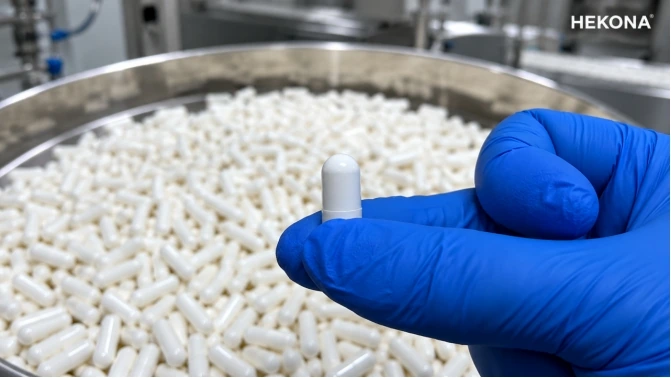
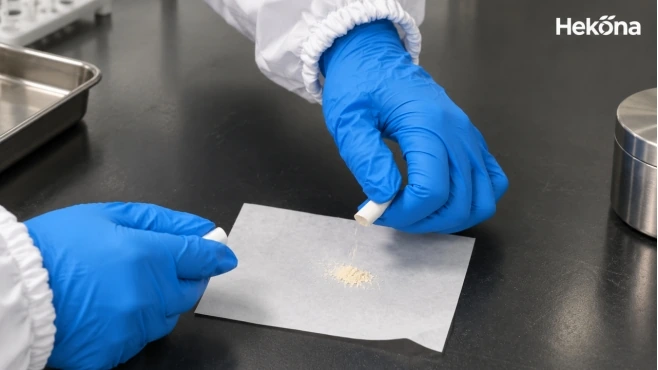
Goud and Hekona link culture handling, capsule filling in digestive health products often designed with protective stuffing. This Hekona capsule manufacturing process is also representative of the wider path, from incoming checks and weighing through blending, filling, in-process inspection as well as metal detection to finished-production testing. The Hekona capsule production process again illustrates the wider path from incoming checks and weighing through to blending, filling, in-process inspection with metal detection diagnosis (inspection) and finished-product testing
For a probiotic batch record, “handle carefully” is not enough. The relevant temperature, humidity, time, hold, and sealing controls need to be translated into reproducible instructions.
7. Packaging Is Part of the Formulation Strategy
For probiotics, package selection should not be left until the formula is already locked. The package helps determine how quickly moisture and oxygen can reach the product over time.
The practical probiotic-production review cited above links shelf-life viability with package moisture-vapor transmission performance. Lower moisture ingress helps preserve a low-water-activity system. Oxygen control can also matter for oxygen-sensitive strains.
A package assessment can include:
- bottle resin or blister structure;
- moisture-vapor barrier;
- oxygen barrier;
- closure and induction seal;
- desiccant where appropriate;
- oxygen-control options where justified;
- headspace;
- capsules per package;
- storage statement; and
- expected distribution climate.
Its not just bottle versus blister of course. The barrier properties of different bottle materials and blister structures are hugely varied. Even though it is a high-barrier bottle, and has a good sealing system (and even desiccant), would work properly. Unit-dose blisters with a high barrier may provide another benefit: When one dose is removed, the capsules that are left in continue to be individually sealed.

8. A 30-Capsule Bottle Is Also a 30-Day Use Scenario
Consider a simple commercial format: 30 capsules per bottle, one capsule per day.
It is opened approximately once a day for around one month. Once the first capsule is opened, the others no longer exist in a sealed environment as they did when batch released. The openings can exchange air with the surrounding environment; whether that venting is an advantage depends in part on how humid a climate you live — and how moisture-sensitive your formula.
This creates two different stability questions:
- Unopened shelf life: can the sealed commercial pack protect the product through the stated storage period?
- In-use period: after opening, can the remaining product tolerate the repeated use pattern expected from the consumer?
It may be useful to get a comparison for a high-barrier unit-dose blister for once daily probiotics where the opening of one dose does not expose all other doses due to the same event. That is an advantage in developing packaging, not a demonstration that all blisters will dominate over all bottles. That is an advantage in development of packaging, not a proof that each blister will beat the hell out of every bottle
The most defensible approach is to compare the actual candidate packaging systems under relevant stability conditions, using the real commercial capsule and fill.
9. Overage Is a Margin, Not a Substitute for Stability Design
Probiotic manufacturers commonly use an overage to compensate for expected viability loss during manufacture and shelf life. The principle is legitimate, but the size of the overage should have a technical basis.
Adding more culture cannot repair:
- a high-water-activity formulation;
- a weak moisture barrier;
- uncontrolled heat exposure;
- excessive oxygen exposure;
- poor manufacturing holds;
- an unsuitable analytical method; or
- missing shelf-life evidence.
Probiotic overfilling is well documented and costs more than necessary in µgù. A more economic approach is maintaining the microorganism viability via formulation, appropriate freeze-dry/protection technology followed by proper packaging and lacks process design that needs to use a sufficient overage coverage for anticipated residual loss. This is the meaningful rationale for developing viable product by formulation, freeze-drying/protection technology, packaging and process design that you know to result in some loss but then supplementing with a rational overage just enough to make-up based on expected losses.
See this review of probiotic overfilling and viability preservation.
In other words: control avoidable loss first, then calculate the margin. Do not start by assuming large losses and solving the problem only by adding more culture.
10. End-of-Shelf-Life CFU Requires Finished-Product Stability Evidence
If a brand wants the finished product to meet a defined CFU minimum at the end of shelf life, theory and raw-material documentation are not enough. The stability plan should be built around the sellable product.
At minimum, the protocol should identify:
- final strain set;
- final formula;
- final capsule shell;
- commercial package;
- storage condition;
- enumeration method;
- test intervals;
- release criterion;
- shelf-life criterion; and
- how trends and near-limit results will be reviewed.
Probiotics are, in practical terms, biologically active systems and as such to find reliable accelerated models that can universally predict long-term probiotic viability is not possible (as it could be for some conventional chemical ingredients). While comparing formulas or packages at an accelerated pace, and subsequently seeing the risk profile sooner is beneficial, real-time stability remains a key factor in providing support towards achieving a long shelf-life CFU target.
The eight checks performed by Hekona en route to capsule production can be expanded for a probiotic project with strain identity, CFU time point, enumeration method (e.g. direct plating? Bactrol?), water-activity strategy and commercial-package stability added in the approval file. The format of Hekona (Hekona, 2016) can be extended for the probiotic project by eight checks before observational capsule production files: strain identity; CFU time point; enumeration method and water-activity strategy; commercial-package stability.
11. Make the CFU Claim Traceable From Culture to Finished Pack
A probiotic claim should be supported by a connected technical file rather than a single COA.
At review, place these records together:
- raw-material specification and supplier COA;
- approved strain list and formula;
- batch record and any lot-specific potency calculation;
- finished-product specification;
- release COA;
- commercial-pack specification;
- stability protocol and reports; and
- approved artwork.
Starting culture is described by the supplier COA. It cannot explain what took place in this brand’s blender, capsule filler, packaging line, distribution route or storage window. An early finished batch is described by a release COA. It cannot see the future. It is the stability program that connects commercial pack to a proposed shelf-life claim.
For instance, Hekona also has a finished-product assurance page describing company-wide measures like “finished sampling,” selected content and physical checks, package inspection, batch documentation and traces. For a probiotic project, those controls should be refined to the strains being used with values for CFU method limits package and stability plan which were agreed upon earlier on between developer (see sections 6 through 10). These controls, for example on a probiotic project are now limited to the strains agreed upon initially, CFU method (if required), limits and limitations with respect to package/ stability plan
12. A Practical Six-Layer Framework for Probiotic Shelf-Life Design
| Layer | What to Control | Why It Matters |
| 1. Strain | Identity, strain code, incoming potency, temperature/moisture/oxygen sensitivity | Different strains can have very different viability profiles. |
| 2. Formula | Carrier, water activity, prebiotics, hygroscopic ingredients, excipients | The full matrix can change moisture and viability behavior. |
| 3. Capsule | Gelatin vs HPMC; delayed-release or enteric protection where justified | The shell affects moisture interaction; release technology addresses a separate GI-survival question. |
| 4. Process | Material conditioning, temperature, RH, exposure time, holds, sealing time | Viability can be lost before the product reaches the stability chamber. |
| 5. Package | Bottle/blister barrier, seal, desiccant, oxygen strategy, count per pack | The package controls moisture and oxygen ingress and the consumer use pattern. |
| 6. Stability | Commercial pack, method, pull points, limits, trend review | This is the evidence that connects release potency to the proposed shelf-life claim. |
13. Keep US Labeling Review Separate From the Manufacturing Target
For products intended for the United States, the technical objective and the regulatory label review should not be treated as the same question.
FDA Opnd26; re: use of CFU (and quantity by weight under enforcement-discretion policy) math in regard to a draft guidance on quantitative labeling of dietary supplements containing live microbials[9995] The guidance document is still in draft form and very clearly contains non-binding recommendations. The document remains as draft guidance and clearly states that it provides only non-binding advice.
It implies that an article must not reduce the issue to saying ” US law says every probiotic has to guarantee labeled CFU through expiration. Half of the proposed label should be printed while brand continues defining its quality target, then have it reviewed against current destination market requirements. Clearly, the company will need to specify what its quality target is and then get this label compared against existing requirements for that market.
14. What a Brand Should Send the Manufacturer Before Quotation
A request that says only “Please quote a 20-billion-CFU probiotic capsule” leaves too many variables open. A useful project brief should include:
- strain names and identifiers;
- single- or multi-strain design;
- target CFU per serving;
- whether the target applies at manufacture/release or at end of shelf life;
- proposed shelf life;
- complete formula and prebiotic system;
- serving size;
- capsule preference;
- whether delayed release or enteric protection is being considered;
- target market;
- bottle or blister preference;
- count per pack;
- storage statement;
- distribution expectations;
- first-order volume and forecast;
- finished-product test expectations; and
- stability expectations.
With that file, Hekona’s manufacturing capabilities can be assessed against a real commercial project rather than a headline CFU number.
Conclusion: The Real Question Is Not How Many CFU Go In, but How Many Remain
For a Probiotic company, the production-day count is just the tip of their Product life cycle. The consumer gets a product that has gone through manufacturing, packing, shipment storage opening and repetitive uses. The consumer is the end recipient of a product that has gone through manufacturing, packing & shipment (to both B2C and wholesale), storage in cold chain + opening as needed between uses using different utensils for each frozen product.
Thus, a strong end-of-shelf-life CFU strategy integrates strain selection with formula water activity and capsule shell; production humidity/temperature; exposure times; package barrier rational overage (Q10 factors) for low moisture contents yet also helps to provide real-time stability evidence. This robust end-of-shelf-life CFU strategy links strain selection to formula water activity, capsule shell and production humidity & temperature at time of use, exposure time in the delivery package barrier route that enables overage estimations based on real-time stability evidence.
The better question to ask a probiotic manufacturer is not simply: “Can you make 20 billion CFU?”
I now call it: ”How will you develop and test this product to ensure that the final marketed package is fully capable of supporting our target CFU at end-of-shelf-life?” The question is: “How do you formulate and validate this product in such a way that the final consumer pack can meet our target CFU at end of shelf life?”
That question separates a production-day number from a commercially defensible probiotic product.
FAQ
1. Should a probiotic claim refer to CFU at manufacture or at the end of shelf life?
Through the lens of product quality, a last-sell-by minimum enables greater information transfer to the brand about what is considered acceptable for consumers around expiration. Even when manufacture-time claim is the chosen basis, such a clear position should not be considered evidence of count. We have to see the accurate way of presenting your label for a specific destination market.
2. Can a manufacturer simply add extra culture to guarantee the end-of-shelf-life CFU?
No. While a rational overage can make up for anticipated loss, it cannot remedy high water activity / weak moisture or oxygen protection/ excessive heat exposure/suspect holding at non-production process steps/inappropriate techniques/lack of stability evidence. It is better to ensure that avoidable loss has been controlled first and margin should be derived from the authorised amount later on. You first control avoidable loss and then manipulate a margin (a better sequence)
3. Are HPMC capsules always better than gelatin capsules for probiotics?
No HPMC hard capsules typically begin with a lower level of inherent water compared to classic gelatin shells, so they can be an attractive option for moisture-sensitive probiotic formulations. However, the actual selection still needs to be confirmed with strain blend/fill formula/package/stability program. However, you still need to confirm the final choice with that strain-blend/fill formulation/package/stability program
4. Is blister packaging always better than bottles for probiotics?
How about NO? Barrier performance is determined by the actual materials and package design. Pulling out one capsule from a high-barrier unit-dose blister limits further repeated exposure of unused doses. So even a well crafted high-barrier bottle with an efficient closure-seal and desiccant can work fine. Without only looking into package name, also compare the real candidate packages in stability work!
5. Why do probiotic capsule manufacturers need tight temperature and humidity control?
The freeze-dried probiotic cultures can lose viability when in contact with moisture and at elevated or non-optimal temperatures. As such, during dispensing, blending or filling and even before final sealing these points can influence the starting point for shelf-life stability. Relative humidity, product temperature and exposure time should all be treated as controlled process variables. Maximize relative humidity, optimize product temperature and exposure time as controlled process variables
6. Can accelerated stability testing prove a 24-month probiotic shelf life?
Not by itself. While one can compare formulas, packages and risk conditions using accelerated studies: there is no simply validable accelerate model for predicting long term CFU with all strains/ data or formulations of probiotics. And while up to the time of publication stability remains important, this doesn’t seem as critical for a long shelf-life viability claim. Supporting a long shelf-life viability claim requires real-time stability
Technical note: Check product design, stability requirements and labelling for the specific strains (which citra? used raw form or extract?), formulation package & destination market. The technical values described above are not specifications set for all probiotic products as might be the case with a USP, but simply development directives. The noted technical parameters are development references and not a universal specification for all probiotic products