What buyers should verify beyond the certificate itself
When a supplement brand starts looking for a contract manufacturer, it will often see phrases such as “GMP compliant,” “third-party audited,” or “manufactured for the U.S. market.” Those statements matter, but they are not enough. The more useful questions are:
- Who audited the facility?
- Which standard was used?
- Which legal entity and manufacturing address are covered?
- Which dosage forms and manufacturing activities are within scope?
- Is the certification for the facility or for a specific finished product?
- Most importantly: how does the quality system control your actual batch?
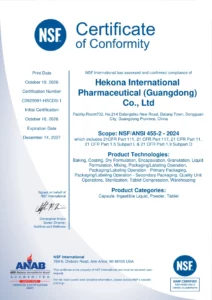
Hekona International Pharmaceutical (Guangdong) Co., Ltd. has been assessed by NSF International and confirmed compliant with NSF/ANSI 455-2:2024. The current certificate lists capsules, ingestible liquids, powders, and tablets, together with manufacturing technologies that include mixing, granulation, encapsulation, liquid formulation, tablet compression, packaging/labeling operations, quality unit operations, sterilization, and warehousing.
1. What Is NSF/ANSI 455-2?
NSF/ANSI 455-2 is a Good Manufacturing Practice standard for dietary supplement manufacturing, packaging, and related operations. NSF describes the 455 series as a framework that brings regulatory expectations, retailer requirements, and industry good practices into an independent third-party audit system. For dietary supplements, the applicable standard is NSF/ANSI 455-2.
That is why buyers should not stop at the NSF logo. They should confirm the exact standard, the certified entity, the facility address, the product categories, and the manufacturing scope.
Authoritative reference: NSF GMP Certification
2. How Does It Relate to U.S. Dietary Supplement GMP Requirements?
The core U.S. dietary supplement GMP requirements are found in 21 CFR Part 111. FDA guidance makes clear that GMP is not simply about a clean facility. It requires a documented manufacturing and quality system covering people, facilities, equipment, quality responsibilities, components, master manufacturing records, batch production records, laboratory operations, packaging and labeling, product release, deviations, returned products, and complaints.
- Personnel and training
- Facilities, sanitation, and equipment control
- Quality unit responsibilities
- Component, packaging, and label controls
- Master Manufacturing Records
- Batch Production Records
- Laboratory testing
- Packaging and labeling controls
- Product release
- Deviation, return, and complaint handling
A mature system is therefore not “receive ingredients, manufacture, test once, ship.” It is: what was approved, what was actually used, who performed the step, who verified it, what was tested, how deviations were handled, who released the batch, and whether the complete history can be reconstructed later.
Regulatory reference: FDA Dietary Supplement CGMP Guidance
3. How Should a Brand Read an NSF Certificate?
Legal Entity
Does the company name on the certificate match the entity actually responsible for manufacturing? If the website brand, sales company, exporter, and manufacturing company differ, understand the relationship.
Facility Address
Certification should follow the actual manufacturing site. A group may own several facilities, but certification at one address does not automatically cover every other location.
Standard Version
Confirm that the certificate specifically identifies NSF/ANSI 455-2 rather than relying on a generic “NSF certified” statement.
Certification Number and Validity
Record the certification number, initial certification date, and expiration date in the supplier qualification file rather than leaving them only in sales correspondence.
Product Categories
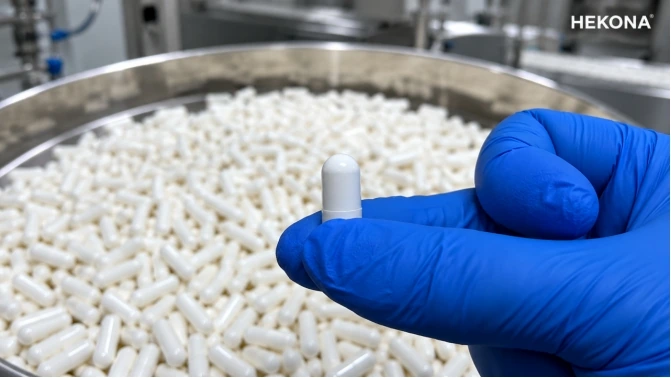
HEKONA’s current certificate lists capsule, ingestible liquid, powder, and tablet. Buyers should confirm that the dosage form they intend to manufacture is actually within scope.
Manufacturing Technologies
Dosage form alone is not the full story. The certificate also lists relevant manufacturing operations such as mixing, encapsulation, granulation, liquid formulation, tablet compression, packaging/labeling, quality unit operations, sterilization, and warehousing.

4. Why “Do You Have GMP?” Is Only the First Question
A professional supplier audit should continue from the certificate into raw materials, production records, laboratory controls, labeling, and batch release.
| Audit stage | What the brand should verify |
| Before materials enter production | How are suppliers approved? Does each material have an approved specification? How is each lot received, verified, and traced? |
| Before a formula enters commercial production | Which version is approved? Are material form, label target, and batch input aligned? Who reviews a supplier or specification change? |
| During manufacturing | Are Master Manufacturing Records and Batch Production Records controlled? Are critical dispensing and additions verified? Are equipment maintenance and calibration documented? How are deviations investigated? |
| At finished-product release | What is the finished-product specification? Do results match the correct lot, method, unit, and limit? Are packaging and artwork the approved versions? Who has final release authority? |
5. Facility Certification Is Not the Same as Product Certification
This is one of the most common misunderstandings. NSF/ANSI 455-2 primarily addresses the manufacturing facility and its GMP system. It does not mean that every product manufactured in that facility automatically receives NSF product certification.
Facility certification asks: “Has this manufacturer established and operated an appropriate manufacturing and quality system?” Product certification asks a different question: “Has this specific finished product gone through the applicable product certification review and testing program?”
6. What NSF/ANSI 455-2 Does Not Automatically Prove
- It does not automatically prove that every formula complies with every destination market.
- It does not automatically prove that every label version is correct.
- It does not automatically prove that every ingredient is appropriate for a specific project.
- It does not automatically establish a 24-month shelf life.
- It does not certify a clinical benefit or therapeutic outcome.
Certification supports the manufacturing system. Each finished product still needs its own formulation review, ingredient specifications, test plan, label review, stability strategy, and batch-release documentation.
7. Follow the Quality System Back to the Raw Materials
After reviewing the facility certification, the next step is the material system. HEKONA’s Raw Material Sourcing page outlines supplier qualification, incoming document review, in-house verification, third-party testing, and lot traceability.
Useful traceability is not simply “we have a procedure.” A finished-product lot should be traceable back to the actual supplier, material code, and raw-material lot used, and a raw-material lot should be traceable forward to the finished batches that consumed it.
For a deeper look at the role of supplier and finished-product reports, see Supplier COA vs Finished-Product COA
8. The Certification Must Reach the Master and Batch Records
A formula sheet tells the factory what the product is intended to contain. It does not fully define how the product will be made consistently. Commercial manufacturing requires controlled instructions for materials, quantities, theoretical yield, processing steps, critical controls, sampling, packaging, and labeling. Each commercial batch then needs its own Batch Production Record.
Repeatable manufacturing should not depend on one formulator or production manager “remembering how it was done.” It should depend on controlled documents, version control, recorded execution, and review.

9. Laboratory Capability Is More Than a List of Instruments
A buyer should ask what the laboratory capability actually solves for the specific formula. HEKONA’s Laboratory Testing Capabilities page explains how analytical and quality-control tools are applied across different materials and products.
A magnesium capsule, a standardized botanical product, and a probiotic formula do not need identical test panels. Technical strength is not “the more tests, the better.” It is whether the test plan matches the formula, specification, risk, and destination market.

10. A Finished-Product COA Is Important, but It Is Not the Whole Quality System
A meaningful finished-product report should connect back to the Batch Production Record, finished-product specification, method, lot number, packaging, and final release decision. HEKONA’s Finished Product Assurance page explains final sampling, testing, packaging checks, batch documentation, and traceability.
A useful quality chain is: Supplier COA → incoming control → Master Manufacturing Record → Batch Production Record → in-process control → finished-product testing → packaging/label review → quality release. Certification should support this entire chain, not just the certificate page.
11. How to Use NSF/ANSI 455-2 in a Real Supplier Audit
| Audit level | What to verify |
| Level 1: Certificate authenticity and scope | Legal entity, facility address, standard version, certification number, validity, product categories, manufacturing technologies |
| Level 2: Facility quality system | Supplier approval, incoming control, traceability, production records, deviations, change control, laboratory, packaging/labeling, release |
| Level 3: Your specific product | Ingredient specification, formula version, test standard, pack, artwork, stability requirements, lot traceability, final release responsibility |
12. How HEKONA’s Certified Scope Connects to Actual Manufacturing
The certificate is the starting point. Brands should continue into the actual dosage-form pages and manufacturing route relevant to their project:
- Manufacturing Capabilities
- Capsule Manufacturing
- Tablet Manufacturing
- Powder Manufacturing
- Liquid Fill Manufacturing
This is more useful than displaying an NSF logo in isolation, because it shows how the certification connects to real manufacturing operations.
Buyer’s Quick Supplier Audit Checklist
| Audit module | What to confirm |
| Certificate | Entity, address, standard, certification number, validity, product category, manufacturing scope |
| Raw materials | Supplier approval, specifications, incoming verification, lot traceability |
| Manufacturing | Master record, batch record, dispensing verification, equipment status, deviation handling |
| Laboratory | Does the test panel match the product risk, method, specification, and destination market? |
| Packaging / label | Approved pack version, artwork version, lot code, seal, and release status |
| Finished-product release | Specification, results, release record, batch documentation, traceability |
Conclusion: Use the Certificate to Start Supplier Qualification, Not to Replace It
The real value of NSF/ANSI 455-2 is not that it makes a manufacturer look more professional. It provides a third-party basis for evaluating the manufacturing quality system.
Mature brands do not stop after seeing the certificate. They continue into manufacturing capability, raw-material control, production documentation, laboratory testing, packaging and labeling, finished-product release, and the requirements of their own project.
The better question is not simply “Are you NSF certified?” It is: “How does your certified scope and quality system control my product?”
FAQ
Is NSF/ANSI 455-2 a facility certification or a product certification?
It primarily addresses GMP systems for dietary supplement manufacturing, packaging, and related facilities. It is different from certification of a specific finished product.
Does manufacturing in an NSF/ANSI 455-2 certified facility allow the product to use an NSF product certification mark?
No. Facility certification does not automatically confer independent product certification on every customer product. Product certification requires a separate program and evaluation.
What should a brand check first on an NSF certificate?
At minimum: legal entity, manufacturing address, standard number, certification number, validity, product categories, and manufacturing technologies.
Do raw-material and finished-product COAs still matter if the facility is NSF/ANSI 455-2 certified?
Yes. Certification evaluates the facility quality system; each project still needs its own material specifications, incoming controls, production records, finished-product specifications, testing, and release documents.
Does NSF/ANSI 455-2 prove that a product complies with every U.S. requirement?
No. The specific formula, label, claims, product category, and destination-market requirements still need separate regulatory review.
If two manufacturers both have NSF certification, what else should a brand compare?
Compare dosage-form experience, ingredient qualification, formulation capability, laboratory and third-party testing, traceability, packaging capability, change control, project documentation, communication, and execution.
Explore HEKONA: Homepage | Manufacturing Capabilities | Laboratory Testing Capabilities