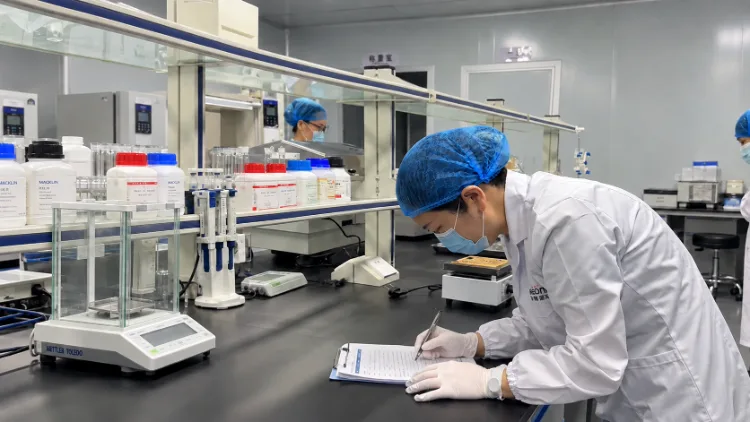
A capsule sample can look finished before the product is actually ready for production.
The shell closes properly. The color looks right. The bottle presentation is approved. But for a brand moving from development to commercial manufacturing, those points only answer part of the question.
The more important question is:
Can the same formula be manufactured, tested, packaged and documented consistently at production scale?
For a multi-ingredient capsule, sample approval should therefore cover more than appearance and taste. It should confirm that the formula version is clear, the raw materials match the intended specifications, the blend can be handled by production equipment, and the finished product has a defined testing and packaging plan.
At Hekona, we separate early formulation samples from production-scale decisions. A manually filled prototype can be useful for confirming direction, but it does not automatically prove that the same blend will run consistently on an automatic capsule filling line.
Before approving a complex capsule formula for commercial production, these are the eight areas worth checking.
Formula and Material Checks Before Capsule Sampling
1. Confirm Exactly Which Formula the Sample Represents
This sounds basic, but it is one of the easiest places for a project to drift.
A formulation team may work in milligrams per capsule while the label is written per two-capsule serving. One document may describe the amount of an extract added, while another declares the standardized marker compound. An excipient may also change during sampling without the label team seeing the revision.
Before approving the sample, the following should agree:
Formula version → Amount per capsule → Amount per serving → Supplement Facts declaration
The controlled formula should also identify the capsule shell, processing aids, carriers, flow agents and any intentional overages that are part of the commercial product.
Under 21 CFR §111.210, the master manufacturing record includes the dietary ingredient amounts, complete component list, declared ingredients, packaging, representative label, sampling instructions and required production controls.
A sample may look correct and still represent the wrong commercial version. That is why formula reconciliation comes before artwork approval or mass production.
Useful question for the manufacturer:
Which formula version was used for this sample, and does it match the proposed serving size and label?
2. Match Every Ingredient to an Approved Specification
Ingredient names alone are not enough for a multi-ingredient formula.
Two materials with similar names may differ in:
- source;
- extract concentration;
- active-marker level;
- carrier system;
- particle size;
- moisture;
- bulk density; or
- assay basis.
Those differences can affect both manufacturing and the final label.
For each material used in the sample, the manufacturer should be able to connect the received lot to an approved raw-material specification.
The Certificate of Analysis is part of that review, but it should not be treated as the only proof of ingredient identity.
For dietary ingredients, 21 CFR §111.75 generally requires at least one appropriate test or examination to verify identity before use, unless an FDA exemption applies. For components other than dietary ingredients, supplier COAs may be relied on when the supplier and the COA have been qualified in accordance with the regulation.
For a brand, the practical question is simpler:
Does the material actually used in the sample match the specification approved for the commercial formula?
If that answer is unclear for one ingredient, the formula is not fully locked.
3. Pay Particular Attention to Low-Dose Ingredients
A formula containing ten ingredients is not automatically more difficult than one containing five.
The bigger issue is often the relationship between:
dose + particle size + density + total blend size
A 5 mg or 10 mg active can be present in the correct total batch quantity and still distribute poorly if it is added directly into a much larger powder blend.
This is why low-dose ingredients may require a pre-blending or geometric-dilution step before they are incorporated into the main blend.
The sample review should answer practical questions such as:
- Which ingredients need a pre-mix?
- What carrier is used?
- In what order are the materials added?
- Which ingredient is used as the uniformity marker?
- Where are blend samples taken?
- What happens if the results are outside the agreed range?
A single pooled sample is not always enough to identify segregation.
For some formulas, samples from different blender locations or different points in the process can give a more useful picture.
The purpose is not to make the sample process unnecessarily complicated. It is to identify the ingredients most likely to create a distribution problem before the batch becomes much larger.
Capsule Fit and Production-Scale Checks
4. Check the Actual Powder, Not Just the Formula Weight
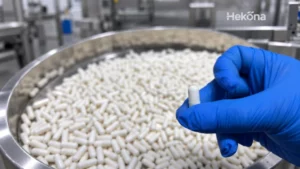
A common early question is:
“Will this formula fit into a Size 0 or Size 00 capsule?”
Ingredient weight alone cannot answer that question.
The same 500 mg formula can occupy very different volumes depending on the bulk density of the finished blend.
Powders may also behave differently once mixed. A blend can:
flow freely, bridge in the hopper, cling to equipment, absorb moisture, agglomerate or segregate.
These properties matter much more on automatic filling equipment than they do when a small sample is filled by hand.
Hekona reviews the final blend before fixing capsule size and commercial filling assumptions. For selected poor-flow or hygroscopic formulas, dry or wet granulation or additional moisture control may be considered, but granulation is not a universal solution. The ingredient stability and final process requirements still need to support that choice.
During sampling, the useful questions are:
Does the blend feed consistently?
Does the target fill fit the chosen shell without excessive compression?
Is the capsule shell suitable for the moisture characteristics of the contents?
If the answer changes when the actual blend is tested, the capsule size or serving structure may also need to change.
5. Separate “Prototype Approved” from “Ready for Production”
This distinction is easy to miss.
At Hekona, manual filling can be used for prototypes and small custom samples. Commercial production uses automatic filling, capsule locking and in-line rejection.
Those two stages do not place the powder under the same conditions.
A hand-filled sample can help confirm:
capsule appearance, approximate fill volume, shell preference and early formulation direction.
It does not reproduce the feeding, dosing, vibration, locking and rejection conditions of an automatic production line.
For this reason, we prefer to separate three decisions:
Laboratory sample
Is the formulation direction workable enough to continue?
Pilot or representative trial
Can the proposed blend and filling process transfer to more realistic production conditions?
Production approval
Are the formula, specifications, test plan, packaging and label versions controlled?
If the sample used temporary excipients, hand sieving or another laboratory-only step, that should be recorded rather than quietly disappearing between sample approval and commercial manufacturing.
6. Review Fill Weight, Capsule Closure and Physical Condition
A capsule sample is a dosage form, not just a visual mock-up.
The final approval should cover the physical characteristics that matter during filling and release.
Typical items include:
- target fill weight and agreed variation;
- capsule closure and locking;
- splits, dents, loose caps or telescoping;
- powder leakage or excessive powder on the shell;
- shell color and appearance;
- moisture-related changes; and
- how rejected capsules are identified and handled.
One point is particularly important:
Do not copy acceptance limits from an unrelated product.
A dense mineral formula, a hygroscopic botanical formula and a capsule containing several low-dose actives may need different controls.
The finished-product specification should reflect the actual formula and process.
Testing, Packaging and Version Control
7. Agree on the Finished-Product Test Plan Before Production
“We will test it later” is not a useful sample-approval decision.
Before production, the brand and manufacturer should know which finished-product requirements matter for that formula.
Depending on the product and target market, this may include:
| Review Area | Typical Question |
| Identity / Composition | Which ingredients or markers need verification? |
| Potency | Which actives are quantified, and by what method? |
| Microbiology | Which microbial limits apply? |
| Contaminants | Are heavy metals, pesticides or other contaminants relevant? |
| Physical Quality | What fill-weight, appearance, lock or disintegration checks apply? |
| Stability | Which attributes need to be monitored to support shelf life? |
HEKONA’s laboratory capabilities include active-ingredient analysis, physicochemical testing, microbiological testing, heavy-metal analysis, particle-size analysis and capsule-related physical testing. The actual test plan, however, should be built around the specific formula rather than around a generic laboratory menu.
21 CFR §111.75 also requires finished-batch verification to be tied to established product specifications and an appropriate sampling rationale.
For the brand, the practical output should be clear:
What must the commercial batch pass before it can be released?
8. Freeze Packaging, Label Inputs and Version Control
Formula approval is not the end of the technical work.
Before production starts, the commercial version also needs to identify the packaging configuration and label that belong to that formula.
This normally includes:
bottle, blister or pouch; closure and seal; desiccant where applicable; capsule count; net quantity; Supplement Facts inputs; lot and expiration-code location; and approved artwork version.
This matters because packaging changes can sometimes affect the product itself.
A moisture-sensitive blend packed in a different bottle or without the planned desiccant is not necessarily the same commercial system that was evaluated during development.
The same principle applies to records.
21 CFR §111.255 requires a batch production record for every manufactured batch, and that record must accurately follow the applicable master manufacturing record.
For the brand team, this means the approved sample, formula, packaging and label should all point to the same version.
If a supplier, raw-material specification, capsule shell, fill target, process, packaging component or label input changes later, the team should decide whether that change requires a new sample or another approval step.
A Practical Capsule Sample Handoff
When sending a multi-ingredient capsule project to Hekona, a structured technical package is much more useful than a product name and ingredient wish list.
Before moving toward commercial production, we recommend confirming:
| Area | What Should Be Clear |
| Formula | Controlled formula version, per-capsule amount and serving basis |
| Materials | Approved specifications and sample-lot references |
| Mixing | Pre-mix needs, addition order and uniformity approach |
| Powder Behavior | Flow, density, moisture sensitivity and capsule fit |
| Filling | Fill target, closure and physical acceptance points |
| Testing | Formula-specific finished-product and stability plan |
| Packaging & Label | Commercial packaging and approved artwork inputs |
| Records | Formula, packaging and production versions are traceable |
This does not mean every project needs the same amount of documentation at the first sample stage.
A simple single-ingredient capsule and a complex formula containing multiple botanical extracts, minerals and low-dose actives do not present the same manufacturing risks.
The purpose is to identify the decisions that matter for this formula, then confirm them before the cost and complexity of the batch increases.
When Is a Capsule Sample Ready to Move Forward?
A good sample should answer more questions than it creates.
It should tell the brand:
which formula was used,
whether the raw materials match the intended specifications,
how the difficult ingredients will be handled,
whether the blend fits the proposed capsule and process,
what still needs to be confirmed at pilot or production scale, and
what the finished batch will need to pass before release.
For a multi-ingredient capsule, approving the appearance alone is not enough.
The safer handoff is:
Formula → Materials → Process → Testing → Packaging → Label → Controlled Production Version
When those pieces point to the same commercial product, the sample has done its job.
If you are preparing a complex capsule formula, Hekona can review the formula, serving structure, capsule fit, sampling requirements and next production step before commercial manufacturing.
FAQ
Is one approved capsule sample enough to begin mass production?
Not always.
A manually filled or laboratory sample can confirm early formulation decisions, but any important assumptions that change on commercial equipment should be reviewed at a more representative stage. Formula, testing, packaging and label versions should also be controlled before commercial production.
What should a brand request with the final capsule sample?
At minimum, the brand should understand which formula version was used, which material lots were involved, how the sample was prepared, what manufacturing risks remain unresolved, what finished-product testing is planned, and which packaging and label version will be used for production.
Why is a capsule sample review important before commercial production?
A capsule sample review helps brands confirm whether the formula can be manufactured consistently at production scale. A sample that looks correct may still have issues with ingredient compatibility, powder flow, capsule filling performance, testing requirements, or packaging suitability. Reviewing these factors early can reduce production risks and unexpected changes after mass manufacturing begins.