
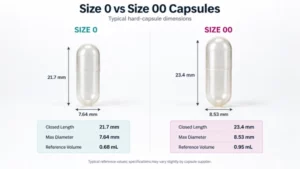
Choosing between capsule size 0 vs 00 is not a matter of picking the shell that holds the largest number on a chart. Size 00 has roughly 40% more body volume than size 0, so it can accommodate more of the same powder. Size 0, however, is shorter and narrower. That difference can matter to the person swallowing it and to a brand trying to keep the daily serving practical.
The sensible decision is to start with the finished formula. Confirm the active amount, excipient allowance, bulk density, flow behavior, and target number of capsules per serving. Then run a pilot fill in both candidate shells. A spreadsheet estimate can narrow the options, but it cannot show whether a real blend will meter cleanly, lock correctly, and remain stable in the selected package.
Capsule Size 0 vs 00 at a Glance
The following figures are suitable for preliminary estimation during product development and are based on published research on hard capsule specifications. A Size 0 capsule has a reference volume of approximately 0.68 mL, while a Size 00 capsule has a reference volume of approximately 0.95 mL. Capsule volume should not, however, be treated as a fixed fill weight. Actual capacity can vary depending on powder bulk density, particle size, formulation composition, and filling process, so the final capsule size should be confirmed through trial filling with the actual formulation.
| Decision Point | Size 0 | Size 00 | What It Means for a Brand |
| Theoretical body volume | About 0.68 mL | About 0.95 mL | Size 00 offers roughly 40% more volume |
| Illustrative fill at 0.40 g/mL | About 272 mg | About 380 mg | A denser or more compacted blend changes the weight |
| Relative external size | Smaller | Larger | The filled prototypes should be assessed by the intended user |
| Typical commercial advantage | Smaller unit | More room per capsule | The best choice depends on serving design |
These reference weights illustrate why a capsule cannot be selected from ingredient milligrams alone. A light botanical powder and a dense mineral blend can occupy very different volumes at the same weight. Granulation, particle-size distribution, flow aids, and the dosing system can also change how consistently the powder packs.
A Useful First-Pass Calculation
For an early estimate, divide the target fill mass by the expected tapped bulk density. A 500 mg blend at 0.70 g/mL requires about 0.71 mL before allowing for process variation. On paper, that sits above the reference body volume of size 0 and below that of size 00. In practice, the formulation team still needs to test the actual blend because the machine does not fill an ideal, perfectly uniform powder.
The opposite situation is equally important. If a formula occupies only a modest portion of size 00, selecting the larger shell may add no formulation benefit. A smaller shell or a revised excipient system may provide a cleaner commercial design.
Why Milligrams Alone Cannot Select a Capsule
A Supplement Facts panel tells you how much of each declared dietary ingredient is in a serving. It does not tell you the final powder volume, shell weight, or behavior of the blend on a production line. Three variables usually decide whether the design is workable.
Bulk Density Changes the Space Required
Bulk density describes how much mass occupies a given volume before or after settling. Fluffy plant powders may need far more space than compact crystalline ingredients. Two formulas that both total 400 mg can therefore require different capsule sizes.
Ask the manufacturer for measured loose and tapped bulk density on the proposed blend, not a value copied from a single raw-material specification. The combined formula is what enters the dosing chamber. If the blend separates, bridges, or traps air, an attractive theoretical calculation can become unreliable.
Flowability Affects Fill-Weight Consistency
A powder must move from the hopper into the dosing system in a repeatable way. Poor flow can cause underfilled units, wider weight variation, powder loss, or locking problems. The response may involve particle-size adjustment, a suitable flow aid, or dry or wet granulation. Each change can alter density, so the capsule calculation should be repeated after the process is finalized.
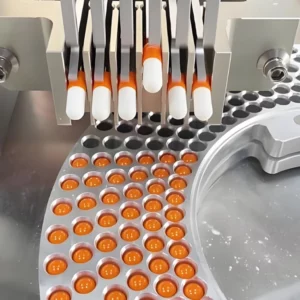
Hekona’s current capsule manufacturing process includes blending, optional granulation, filling and locking, polishing, metal detection, and finished-product testing. The same page lists sizes 1, 0, and 00. For a brand, the important point is not simply that the equipment accepts a shell. It is whether the approved formula can be reproduced on the intended machine and production scale.
Excipients Need Space Too
Flow aids, fillers, anti-caking agents, or stabilizing excipients may be necessary even when the active ingredients appear to fit. Reserving no space for them creates pressure to overpack the capsule or quietly reduce the declared dose. The fill target should therefore be based on the complete master formula rather than the headline actives.
How Size Affects Serving Count and Swallowability
The commercial decision often becomes a trade-off between one larger capsule and two smaller capsules. Neither route is automatically better.
One size 00 capsule can reduce the number of units per serving. That may simplify the directions and reduce the total number of shells, but the larger diameter may be less comfortable for some consumers. Two size 0 capsules create a smaller individual unit and more flexibility for dividing the dose, while increasing capsule count, shell usage, bottle count, and the number of units a customer must remember to take.
Treat Swallowability as a Design Input
The FDA’s guidance on tablet and capsule physical attributes is written for generic drug products, not dietary supplements. It should not be presented as a supplement requirement. It is still a useful reminder that physical size and shape can affect swallowing experience and adherence.
For a supplement brand, this means considering the target user before approving the shell. A general adult sports-nutrition product and a formula aimed at older adults may warrant different serving designs. Consumer research should use the real filled capsule because weight, surface, color, and coating can change perception.
Serving Count Changes More Than the Directions
Moving from one capsule to two capsules per serving can affect:
- capsules and shells required per bottle;
- bottle size, desiccant space, and label dimensions;
- counting and packaging time;
- freight weight and monthly product cost;
- the number of servings communicated on the label; and
- the risk that consumers take only part of the intended serving.
These consequences should be modeled before artwork is approved. A shell change late in development can force revisions to the formula, Supplement Facts, directions, bottle, and cost sheet at the same time.
What to Verify in a Pilot Fill
A pilot batch turns capsule size 0 vs 00 from a chart discussion into a manufacturing decision. The goal is not to make a few attractive samples. It is to learn whether the formula and shell behave predictably together.
1. Measure the Complete Blend
Record loose density, tapped density, particle-size distribution, moisture behavior, and flow. If granulation or an excipient change is introduced, test the revised blend rather than relying on the original measurements.
2. Compare Fill Performance
Run both candidate sizes where the formula is close to the boundary. Review average net fill, variation across sampled capsules, powder loss, capsule closure, dents, splits, and external residue. A shell that technically holds the powder but requires aggressive packing may be a weak choice for scale-up.
3. Confirm Finished-Product Tests
Fill weight is only one release point. Disintegration, content uniformity where applicable, microbiological limits, packaging integrity, and stability planning also matter. Hekona’s finished-product assurance process describes sampling for fill-weight variation, disintegration, and microbiological limits, together with automated packaging and batch documentation.
4. Review the Real User Experience
Compare the two filled options with the intended audience. Do not ask only which capsule looks smaller. Ask whether the complete serving feels manageable, whether the directions are easy to follow, and whether the bottle presentation still fits the intended price and positioning.
5. Freeze the Specification
Once the brand approves a size, the master formula, shell supplier and material, color, printing, target fill weight, acceptable variation, package, and test plan should all reflect that decision. A reorder should not reopen the question unless an ingredient or process change makes the original choice unsuitable.
Applying the Decision to Urolithin A & PQQ
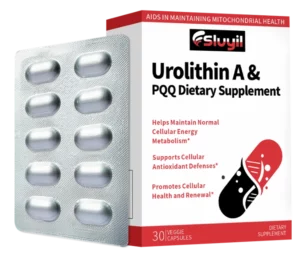
Hekona’s Urolithin A & PQQ product provides a practical example of why serving design must be confirmed from the approved specification rather than inferred from a product photograph. The current product page identifies a Urolithin A and PQQ capsule concept, but it does not identify the shell as size 0 or size 00.
It would therefore be inaccurate to assign a size from the photograph. A private-label brand using this product as a reference should ask for the current finished-product specification, complete formula, shell specification, target net fill, and pilot-fill data before choosing a capsule size for its own version. This also avoids carrying a web-page or artwork revision into a new custom specification without review.
This is especially important if the formula changes. Increasing Urolithin A, adding another active, changing the excipient system, or switching shell material may change powder volume and flow. The one-capsule serving that works for an established specification may not transfer unchanged to a customized formula.
Hekona’s related Urolithin A and PQQ formulation guide makes the same practical point: compare target dose, capsule size, capsules per serving, and likely consumer preference before approval. Brands can use an existing product to define the commercial target, then use formulation measurements and pilot fills to decide whether size 0, size 00, or a different serving structure can reproduce that target reliably.
Conclusion
The capsule size 0 vs 00 decision should connect formulation science with a realistic product experience. Size 00 offers more volume and may keep a high-fill formula to one capsule. Size 0 is smaller and may be easier for some consumers, but it can require more units per serving. The right answer depends on the complete blend, not the active-ingredient total alone.
Measure density and flow, allow room for necessary excipients, compare pilot-fill results, review the complete serving with the target consumer, and freeze the decision across the formula, label, and packaging specification. That process gives a brand a defensible product choice instead of a capsule selected from a generic chart.
FAQ
Is Size 00 Always Better Because It Holds More?
No. Size 00 provides more volume, but a larger shell may be unnecessary for a compact formula and less comfortable for some consumers. Evaluate the complete serving, target user, and pilot-fill performance.
How Much Powder Fits in a Size 0 Capsule?
There is no single weight that applies to every powder. A supplier chart lists about 0.68 mL of theoretical body volume for size 0, but the filled weight depends on bulk density, particle size, flow, and the filling method.
How Much Powder Fits in a Size 00 Capsule?
A common reference body volume is about 0.95 mL. That does not mean every formula will hold the same number of milligrams. Test the final blend under the intended production conditions.
Can a Brand Replace One Size 00 Capsule With Two Size 0 Capsules?
Potentially, but the change affects shell count, directions, bottle configuration, unit economics, and user behavior. It also requires a reviewed master formula and updated label rather than a simple packaging substitution.
Does Capsule Material Change the Size Calculation?
Standard size designations are broadly consistent, but shell supplier specifications, wall characteristics, machine fit, and formulation compatibility still need confirmation. Use the exact shell that will be used in the pilot and commercial batch.
Which Documents Should a Manufacturer Provide Before Approval?
Request the complete formula, shell specification, target fill weight, pilot-fill results, relevant in-process and finished-product tests, packaging specification, and batch documentation that connects the approved sample to production.