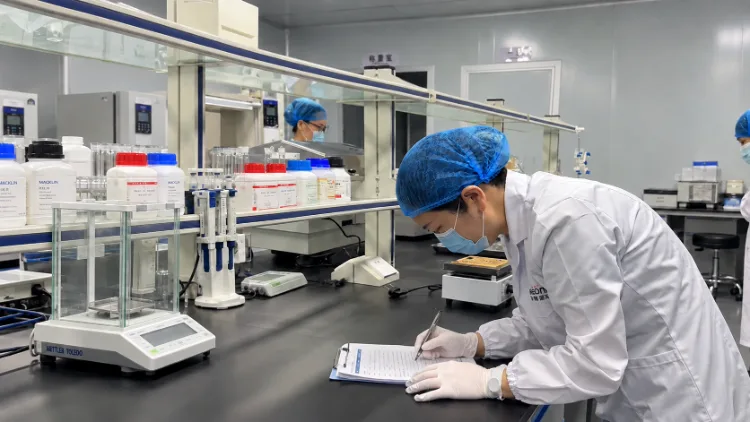
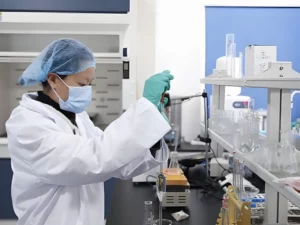
 A Urolithin A and PQQ Supplement Formulation may look simple on a label, yet the real commercial risks sit behind the bottle. Smaller brands often receive attractive quotations without seeing the production site, raw material records, fill-weight data, or batch controls. When delivered capsules differ from the approved sample, a low unit price stops being an advantage.
A safer route separates market testing from full customization. You can first review an established formula, its documents, and a practical quantity of bottled samples. Once real feedback supports the direction, you can decide whether exclusive dosages, capsule materials, excipients, or packaging justify the added work.
Why Is the Formula More Complex Than It Appears?
Combining Urolithin A and PQQ is not simply a matter of placing two powders in one capsule. The formula needs a clear purpose, a workable serving size, and a process that can reproduce the same result across every bottle.
Complementary Product Positioning
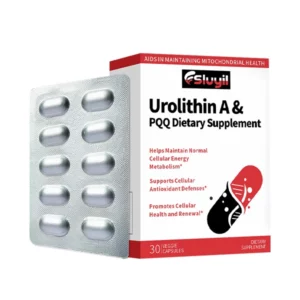 Urolithin A is commonly used in products related to mitochondrial quality and healthy cellular function, while PQQ often appears in cellular energy concepts. The established Urolithin A and PQQ capsule formula gives overseas supplement businesses a practical reference before they invest in an exclusive version.
Urolithin A and PQQ Supplement Formulation Structure
A meaningful Urolithin A dose may occupy much of the capsule volume, while PQQ is usually added at a far lower level. The low-dose component must remain evenly dispersed through a larger powder mass.
Serving size matters too. Before approval, compare target dose, capsule size, capsules per serving, and likely consumer preference.
Ingredient Compatibility Risks
Particle size, bulk density, moisture, oxygen exposure, and capsule-shell behavior all affect production. Compatibility work should review powder flow, water activity, shell material, packaging barrier, and shelf life. These checks help prevent weight variation, clumping, brittle capsules, and potency loss.
What Should You Verify Before Approving the Formula?
A polished sample bottle is not enough to support a commercial order. Your decision should rest on ingredient records, test methods, serving details, and market-specific compliance work.
Raw Material Identity and Purity
Each incoming batch should carry a supplier COA and pass identity, potency, purity, heavy-metal, and microbiological checks. A disciplined raw material sourcing process should connect finished capsules to specific supplier and ingredient lot numbers.
Direct traceability reduces the risk of approving one ingredient grade and receiving another during commercial production.
Serving Size and Capsule Capacity
Confirm whether the declared amount applies to one capsule or the full daily serving. An overloaded capsule may lock poorly or show wider fill-weight variation, while too many capsules may reduce adherence. The best structure balances active amount, realistic capsule capacity, and user convenience.
Claims and Market Fit
Claims should suit the destination market and the available evidence. Structure-function language related to cellular energy or mitochondrial support is usually more appropriate than disease claims or promises of age reversal. Label review should happen before printing.
How Does Manufacturing Control Protect Consistency?
Measurable production limits show how the formula is controlled in practice.
Blend Uniformity
Because PQQ is used at a much lower level than the main ingredient, it should enter the formula through geometric dilution, staged premixing, or another validated method. Adding it directly into a large mixer can produce uneven distribution even when the powder looks uniform.
The documented target is a blend uniformity CV of no more than 5%, supported by multi-location sampling.
Capsule Filling Accuracy
Professional capsule manufacturing controls include in-line weight checks, automatic rejection, polishing, locking checks, and metal detection. The stated fill-weight target is RSD no higher than 2%.
Poor flow may require particle-size adjustment, dry granulation, or suitable flow aids. Without that preparation, advanced equipment may still struggle to deliver consistent contents.
Moisture and Stability Control
For hygroscopic products, water activity may be controlled to Aw 0.4 or below. Controlled rooms, desiccants, and high-barrier packaging help reduce stability risks.
| Documented Point | Stated Capability | Practical Relevance |
| Production Facility | 120,000 sq. ft. | Separate production, testing, and storage areas |
| Annual Capsule Capacity | 2 billion capsules | Capacity for commercial growth |
| Daily Capsule Output | 5 million capsules | Support for repeat orders |
| Mixing Uniformity | CV ≤ 5% | More even low-dose distribution |
| Fill-Weight Variation | RSD ≤ 2% | More consistent capsule contents |
| Hygroscopic Product Control | Aw ≤ 0.4 | Lower moisture-related risk |
Is a Stock Formula or Custom Formula the Smarter Start?
Neither route is automatically better. The right choice depends on how much market evidence you have and which product features genuinely need to be exclusive.
Stock Formula Validation
A mature stock formula lets a small or midsize business review capsules, packaging, documents, and early channel response without funding a complete development project.
When the required bottled capsule product is available, an evaluation quantity of about 100 to 300 bottles may be discussed during commercial negotiations. The final quantity depends on stock and project details, so this is a controlled validation route rather than a fixed public offer.
The aim is to gather evidence before committing to a larger batch.
Custom Formula Differentiation
Custom development suits different active levels, another capsule shell, clean-label excipients, a new serving structure, or exclusive packaging.
If no suitable stock product exists and the formula must follow your specification, sample production generally begins with a 500-bottle custom MOQ. This reflects the added work in sourcing, compatibility checks, trial blending, filling, documentation, and line preparation.
From Sample to Repeatable Production
A sensible sequence is straightforward: review the formula and documents, test a controlled bottle quantity, collect market feedback, adjust only what the evidence supports, and move into OEM or ODM production once the direction becomes clearer.
Request the sample-batch COA, ingredient specifications, batch identification, fill-weight results, microbiological data, and available stability information. Packaging should also be confirmed, including the bottle, cap, induction liner, desiccant, label dimensions, and transport conditions.
Hekona’s wider supplement manufacturing capabilities also allow the dosage form to be reconsidered if the final formula does not suit a standard capsule fill.
Why Consider Hekona for a Lower-Risk Launch?
For smaller overseas supplement companies, a ready formula matters only when its developer, factory, testing, and future customization route are clear.
Sluyil as a Brand Within Hekona
Sluyil is a brand owned by Hekona and forms part of Hekona’s dietary supplement portfolio. It provides access to more than 100 mature, in-stock formulas for early product evaluation and market testing.
Sluyil is not a separate brand sourcing finished goods from an outside factory. Its products are supplied through Hekona’s formulation, sourcing, manufacturing, testing, and documentation system. Sluyil identifies the ready-to-test route within Hekona‘s technical and production foundation. This keeps the sample, its COA, and later production within the same manufacturing system.
One Manufacturing and Quality System
Products offered through Sluyil are backed by Hekona’s integrated manufacturing system, which operates from a 120,000-square-foot facility. The system covers formulation, raw material control, capsule filling, packaging, finished-product testing, and batch traceability.
The formulation and project team coordinates technical review, sample preparation, compliance details, and scale-up. Responsibility therefore does not shift among an unknown supplier, a trading company, and an unrelated factory. Current cooperation focuses on overseas brands and direct international projects rather than domestic trading companies.
A Connected Route From Stock Testing to Custom Production
When a suitable Sluyil formula is in stock, you can begin with a controlled 100 to 300-bottle evaluation rather than paying for new development immediately. This allows you to review the product, documents, packaging, and early market response.
If the formula later needs different active levels, another capsule shell, added ingredients, or exclusive packaging, the project can move into Hekona’s OEM or ODM process. If no suitable stock product exists from the start, the project normally moves directly to the 500-bottle custom sample route.
Sluyil supports early validation, while Hekona supports the technical work needed for a differentiated product. The Urolithin A and PQQ Supplement Formulation can therefore move from stock testing to customization without changing the underlying production and quality framework.
Conclusion
Ultimately, a smarter formulation path turns uncertainty into a sequence of testable decisions. Ingredient records, dosage logic, blend uniformity, fill accuracy, packaging, and market feedback should guide each move from stock evaluation to custom production. A current catalog, sample-batch COA, or formulation compatibility review can clarify those decisions today, helping you protect capital, preserve flexibility, and build a Urolithin A and PQQ Supplement Formulation that remains credible as demand grows.
FAQ
Q1: Can Urolithin A and PQQ Be Used in the Same Capsule?
A: Yes. Serving size, capsule capacity, powder compatibility, blending method, and target-market claims should be reviewed before production.
Q2: What Is the Lowest-Risk Way to Test the Product?
A: When a suitable bottled stock formula is available, about 100 to 300 bottles may be negotiated for product and market review before a larger commitment.
Q3: What Happens When the Required Formula Is Not in Stock?
A: Custom sample development is required. For this bottled capsule project, the usual starting point is a 500-bottle MOQ, subject to formula and packaging complexity.
Q4: Which Quality Records Should You Request?
A: Request ingredient specifications, supplier COAs, the sample-batch COA, batch identification, fill-weight data, microbiological results, and packaging specifications.
Q5: What Makes a Urolithin A and PQQ Supplement Formulation Repeatable?
A: Fixed specifications, validated premixing, controlled filling, suitable moisture protection, approved packaging, documented testing, and full batch traceability.