

Launching a metabolic support line can become expensive long before reliable sales data exists. Small and mid-sized supplement businesses often meet high MOQs, inconsistent samples, or trading companies that cannot provide clear batch records. That makes choosing a capsule manufacturer a quality decision as much as a sourcing decision. A low opening price has little value if the approved sample cannot be reproduced later.
A more measured launch separates product evaluation from full customization. An existing formula can first be checked for composition, packaging, documentation, and channel fit. Once those points are clear, further development becomes easier to justify. This keeps early spending tied to real evidence rather than assumptions about demand.
What Makes a Weight Management Capsule Practical to Launch?
A practical first SKU should be easy to explain, realistic to manufacture, and flexible enough to support later refinement. Formula complexity may look impressive on a specification sheet, but it can create unnecessary cost and compliance work when a new line has not yet been tested.
Clear Market Positioning
Weight management formulas often drift into several directions at once, covering appetite, energy, glucose control, thermogenesis, and general wellness. That can weaken the message.
For an early metabolic support line, a narrower position is usually easier for distributors and consumers to grasp. Metabolic support, everyday energy, and botanical weight-management support can sit together without forcing the product into exaggerated promises.
Focused Formula Architecture
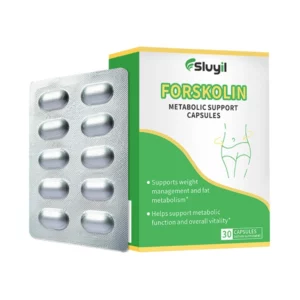
A useful reference is Forskolin Metabolic Support Capsules, which combines Coleus forskohlii extract, green tea extract standardized for EGCG, and B vitamins.
The structure matters more than ingredient count. Coleus forskohlii provides the botanical center of the formula, green tea contributes a recognized polyphenol component, while B vitamins support normal energy metabolism. Each group has a clear role, which makes the finished product easier to explain to buyers and downstream sales teams.
Capsule-Friendly Product Format
Botanical extracts can be bitter, aromatic, dusty, or simply inconvenient in loose powder form. Hard capsules isolate much of that sensory burden while giving each serving a defined format.
Capsules are also familiar across e-commerce, pharmacy, specialty retail, and distributor channels. Bottling, labeling, case packing, and international shipping are straightforward. For a smaller business testing several categories, that simplicity has practical value.
How Should You Evaluate a Metabolic Support Formula?
The Supplement Facts panel is only one part of product evaluation. Buyers should also look at botanical standardization, supporting ingredients, manufacturing feasibility, and the language that may eventually appear on packaging.
Botanical Standardization
A plant name alone does not define botanical quality. Extract strength, marker compounds, identity, and potency specifications affect consistency from one raw material lot to another.
Coleus forskohlii is a good example. A standardized extract provides a measurable purchasing specification instead of a vague botanical powder description. That makes supplier qualification, incoming inspection, COA comparison, and later batch review far more useful.
Supporting Ingredient Roles
Green tea extract and B vitamins should not appear only to make the ingredient list longer. Each addition should contribute to a coherent metabolic support concept while remaining workable in the capsule.
This also leaves room for future refinement. If distributor feedback suggests a simpler formula, a vegetarian shell, or a different serving structure, the changes can be made around a clear base rather than rebuilding an overloaded product from scratch.
Claim and Label Boundaries
Ingredient science and permitted marketing claims are separate issues. Weight management, metabolism, energy, and related expressions need review against the rules of the destination market.
A capable capsule manufacturer should discuss formula feasibility alongside label direction early in development. Correcting a claim before printing is minor work. Correcting thousands of finished labels is not.
What Manufacturing Controls Matter for Weight Management Capsules?
Once the concept is commercially sensible, attention should move to how consistently the formula can be produced. Botanical extracts can differ greatly in particle size, bulk density, moisture behavior, and flowability. These details affect mixing and capsule filling more than many first-time buyers expect.
Raw Material Verification
A structured raw material sourcing system should cover supplier qualification, COA review, identity testing, potency, heavy metals, microbiology, and relevant controls for botanical materials.
This is especially important for overseas SMEs that have encountered intermediaries with limited production visibility. The critical question is not simply whether a supplier can quote the ingredient. It is whether the factory can identify, test, document, and trace the material used in the actual batch.
Blend and Fill Consistency
A metabolic support capsule may combine larger amounts of botanical extract with much smaller quantities of vitamins. If those materials separate during blending, the formula can look correct on paper while individual capsules vary.
Hekona’s hard capsule production system uses controlled blending, optional granulation, automatic filling, polishing, metal detection, and in-process checks. Its process targets include mixing uniformity at CV ≤5% and capsule filling variation at RSD ≤2%.
Those numbers matter because repeatability is what turns an approved sample into a commercial product.
Packaging Protection
The package has to protect the formula after production, not just look attractive on a product page. Depending on the contents, bottled capsules may need desiccants, induction seals, or stronger moisture and light barriers.
International distribution adds another layer. Finished bottles can spend weeks in warehouses and freight networks before reaching the customer. Packaging should therefore be chosen around product stability as well as branding.
| Manufacturing Check | Hekona Capability |
| Facility Area | 120,000 sq. ft. |
| Annual Capsule Capacity | 2 billion capsules |
| 8-Hour Daily Capsule Capacity | 5 million capsules |
| Mixing Uniformity | CV ≤5% |
| Filling Weight Variation | RSD ≤2% |
| Ready-to-Use Stock Products | 100+ formulas |
How Can You Test Demand Before Full Production?
Early sampling works best when it is treated as a decision stage rather than a miniature production order. The right quantity depends on what the buyer is trying to learn and whether an existing product already matches the intended direction.
In-Stock Sample Route
If a suitable metabolic support product is already available in stock, approximately 100 to 300 bottles can be discussed for evaluation during the commercial conversation.
That quantity gives a buyer room to inspect the finished capsules, bottle presentation, sample-batch COA, and general product fit. It may also support controlled distributor feedback or early channel review. Most importantly, it avoids funding a new formulation before an existing direction has been properly assessed.
The point is not simply to place the smallest possible order. It is to buy enough information to make the next decision with greater confidence.
Custom Sample Route
The situation changes when the stock product does not meet the required specification. Adjusting forskolin content, supporting ingredients, capsule shell, serving size, or packaging may require new raw material preparation, trial blending, filling, testing, and separate production records.
For this route, the custom sample MOQ is 500 bottles.
That figure reflects a different scope of work. A 500-bottle custom sample is not a more expensive version of the 100-to-300-bottle stock route. It is a development batch created around specifications that are not already sitting in inventory.
Stage-Gated Scale-Up
The most practical sequence is often straightforward: evaluate stock, collect meaningful feedback, decide what genuinely needs to change, then move into custom sampling and commercial production.
This staged route is particularly useful for smaller businesses. It keeps formula development, inventory, and packaging commitments proportional to what has already been learned. A first order should answer the next business question, not attempt to settle every future product decision at once.
What Should You Compare Before Choosing a Capsule Manufacturer?
Supplier comparison should go beyond unit price. Raw material readiness, technical records, direct communication, and the ability to reproduce an approved specification are often more important once repeat orders begin.
Supply Chain Readiness
A manufacturer with broad production capabilities can handle more of the project within one operating system. That matters when botanical extracts, vitamins, capsule shells, packaging materials, and testing all need coordination.
Raw material continuity deserves particular attention. A change in extract supplier can affect color, density, flow, potency, and filling behavior even when the ingredient name stays the same.
Documentation and Traceability
Before scale-up, buyers should review batch-linked COAs, raw material information, production records, finished-product testing, and packaging specifications.
Batch-linked is the important part. A generic certificate may look reassuring, but it says little about the bottles being evaluated. For overseas buyers dealing directly with a factory, traceable records also help separate real manufacturing control from trading-company promises that are hard to verify.
Reorder Capacity
A successful test creates a new question: can the same product be supplied again without changes that were never approved?
A reliable capsule manufacturer should maintain the agreed specification, raw material controls, packaging format, and quality records as volume increases. Capacity matters, but consistency matters first. Scaling an inconsistent product only makes the inconsistency larger.
Why Consider Hekona for a Metabolic Support Line?
The previous checks provide a practical benchmark for assessing any supplier. Hekona fits this route by combining existing formulas for early evaluation with direct manufacturing resources for later OEM or ODM development.
Hekona Manufacturing Backbone
Hekona covers formulation development, raw material sourcing, capsule filling, quality testing, packaging, and batch traceability. Its production site spans about 120,000 square feet, with annual capsule capacity reaching 2 billion units.
The current service focus is direct overseas B2B business rather than domestic trading-company orders. For smaller international buyers, that shortens the distance between technical questions and the team responsible for the actual product.
Sluyil In-Stock Brand Route
Sluyil is a brand under Hekona and forms part of Hekona’s dietary supplement portfolio. It provides access to more than 100 established stock formulas that can support early product selection and market evaluation.
This is where the stock sampling route becomes commercially useful. If an available formula already fits the intended category, a buyer can first work with the real finished product and its batch documentation. Only after that review is there a reason to decide whether a custom version adds enough value to justify development.
Sample-to-Scale Technical Support
When customization becomes necessary, the same manufacturing system can carry the project into formula review, sourcing, filling, testing, and packaging. Hekona’s R&D and project team includes professionals working across formulation, product research, and manufacturing support.
That continuity reduces one of the common risks in small orders: approving one sample from an intermediary, then receiving something noticeably different when the commercial batch arrives. The sample should establish the production standard, not become an isolated sales piece.
Conclusion
A sensible metabolic support launch is built on evidence, not early volume. The right capsule manufacturer should let you compare a real product, its batch records, and its production path before committing to scale. Reviewing the current catalog, a sample-batch COA, or a formula compatibility assessment can sharpen that decision today. In weight management, disciplined validation turns a first order into the foundation for a repeatable, defensible commercial product line.
FAQ
Q1: What Should a Small Brand Check Before Choosing a Weight Management Capsule Manufacturer?
A: Start with raw material traceability, formula standardization, blending control, fill accuracy, batch-linked documentation, packaging, and reorder capacity. A competitive quotation becomes meaningful only after those manufacturing basics are clear.
Q2: Can a Stock Metabolic Support Product Be Tested Before a Large Order?
A: Yes. When a suitable finished product is already in stock, approximately 100 to 300 bottles can be discussed for evaluation. This route is intended to review the actual product, packaging, sample-batch COA, and market fit before committing to custom development.
Q3: Why Does a Custom Sample Require a 500-Bottle MOQ?
A: A custom product can require new material preparation, formulation review, compatibility checks, trial blending, capsule filling, testing, packaging preparation, and separate batch records. Those steps do not apply in the same way when an established stock product is already available.
Q4: Can the Forskolin Formula Be Changed After Initial Testing?
A: Yes. Ingredient levels, supporting nutrients, capsule shell, serving structure, and packaging can be reviewed after the first evaluation. Proposed changes should be checked for formula compatibility and production feasibility before a custom batch is scheduled.
Q5: What Separates a Reliable Capsule Manufacturer From a Trading Company?
A: A direct manufacturer should be able to show raw material controls, production records, batch-linked test results, filling data, traceability, and a clear route for reproducing the approved product. For a small overseas buyer, that evidence carries more weight than a low price that cannot be tied to the actual factory process.