

A supplement brand already has a Vitamin D3 + K2 capsule formula using MK-4. During a product review, the brand decides to switch to MK-7 while keeping the rest of the formula as close to the original as possible.
On the label, this may look like a straightforward ingredient substitution.
At the manufacturing level, however, the change can affect much more than the ingredient name.
The manufacturer may need to reassess the dose rationale, commercial ingredient grade, active concentration, carrier system, actual dispensing weight, low-dose blending process, capsule fill weight, finished-product stability, and label declarations.
The reason is simple: MK-4 and MK-7 are different forms of vitamin K2, and the commercial materials used to deliver them are not necessarily interchangeable.
For supplement brands, the important question is not simply which form is better. It is which specific ingredient grade can support the intended formulation, manufacturing process, quality requirements, and target market.
HEKONA’s Vitamin K2 + D3 product provides one example of a formulation using MK-7. It can serve as a starting point for discussing this type of product, rather than a universal formula recommendation for every D3 + K2 project.
1. MK-4 and MK-7 Do Not Have a Universal Dose-Conversion Ratio
MK-4 and MK-7 both belong to the menaquinone family of vitamin K2 compounds. However, their research backgrounds and pharmacokinetic characteristics are not identical.
The U.S. National Institutes of Health Office of Dietary Supplements (NIH ODS) identifies both MK-4 and MK-7 as forms used in dietary supplements. It also notes that comparative data on the relative bioavailability of different vitamin K forms remain limited. One study found that MK-7 had a longer half-life than phylloquinone (vitamin K1).
This difference is relevant to formulation development, but it does not establish a universal dose-conversion ratio between MK-4 and MK-7.
Clinical research also illustrates why the two forms should not be compared using dose numbers alone. The NIH fact sheet discusses MK-4 studies using 15 mg or 45 mg per day and an MK-7 study using 180 mcg per day for three years. These studies involved different research designs and endpoints. They do not establish that one form can be substituted for the other at a fixed numerical ratio.
For a commercial product, the dose should therefore be reviewed against:
- The intended product positioning.
- The target market and applicable regulations.
- The scientific evidence relevant to the selected form.
- The intended daily serving.
- The specific commercial ingredient grade.
- The product’s finished-product testing and quality requirements.
A manufacturer should not simply copy the original MK-4 quantity into an MK-7 formula. The dose rationale must be reviewed before the replacement ingredient is approved.
Reference: NIH ODS – Vitamin K: Fact Sheet for Health Professionals
2. “MK-7” Is Not a Complete Commercial Ingredient Specification
A brand may tell its manufacturer that it wants MK-7, but this does not provide enough information for purchasing or production.
MK-7 is available in different commercial grades, including:
- High-purity active material.
- Powder premixes at different active concentrations.
- Oil-based preparations.
- Different carrier systems.
- Materials from different manufacturing sources and processes.
For example, publicly available commercial specifications from Pharmaquinone include MK-7 products in different formats and concentrations, including 0.2% maltodextrin powder. Other commercial specifications identify 1% MK-7 powder using microcrystalline cellulose as a carrier.
These examples demonstrate that two materials described as vitamin K2 as MK-7 can have different manufacturing characteristics.
The supplier specification should be reviewed for:
| Specification item | What the brand should verify |
| Menaquinone form | Confirm MK-4 or MK-7 |
| Supplier and material code | Identify the exact approved commercial grade |
| Active concentration | Confirm the assay and its calculation basis |
| Carrier | Identify maltodextrin, microcrystalline cellulose, oil, or another carrier |
| Physical form | Powder, oil preparation, or other delivery form |
| Identification | Confirm the appropriate identity test |
| Assay method | Review the analytical method and acceptance criteria |
| Isomer profile | Review applicable cis/trans specifications |
| Storage | Confirm temperature, moisture, light, and packaging requirements |
| Shelf life | Review expiry or retest information |
A useful starting point is HEKONA’s Raw Material Sourcing and Quality Control process, which covers supplier qualification, incoming documentation, material verification, and lot traceability.
Explore: Raw Material Sourcing and Quality Control
The important purchasing principle is: Approve a specific commercial grade, not just an ingredient name.
If development approves one material for sampling, purchasing should not automatically substitute another material simply because both are described as MK-7.
3. The Same 100 mcg MK-7 Label Target Can Require Five Times the Premix Weight
This is one of the most important differences between the label and the actual manufacturing formula.
Consider a hypothetical product with a target of 100 mcg MK-7 per serving.
If the selected material contains 1% MK-7: 100 mcg ÷ 1% = 10 mg of premix.
If the selected material contains 0.2% MK-7: 100 mcg ÷ 0.2% = 50 mg of premix.
| Item | 1% MK-7 premix | 0.2% MK-7 premix |
| Target active MK-7 | 100 mcg | 100 mcg |
| Active concentration | 1% | 0.2% |
| Theoretical premix weight | 10 mg | 50 mg |
*This is a mathematical illustration based on the stated concentrations, assuming the declared assay is accurate. It is not a recommended daily dose or a substitute for batch-specific potency calculations.*
The active target remains unchanged, but the total premix weight increases fivefold.
This difference matters because the additional weight is not active MK-7. It is primarily the carrier and other components of the commercial preparation.
For purchasing, comparing the price per kilogram alone can therefore be misleading.
A more useful comparison considers:
- The active MK-7 delivered per kilogram.
- The total material required per production batch.
- The carrier contribution.
- The effect on the complete formula.
- Testing and manufacturing requirements.
- The potential impact on capsule count and packaging.
A lower-cost material per kilogram does not automatically produce a lower finished-product cost. Brands should compare the cost of delivering the same approved active target, not simply the price of two ingredient drums.
4. MK-7 Specifications Should Include More Than the Active Percentage
An ingredient specification stating “MK-7 1%” does not necessarily provide enough information for a complete quality assessment.
The manufacturer should understand what the reported percentage represents and how the active material is controlled.
For MK-7, the specification may include:
- Assay of MK-7.
- Analytical method.
- Identification profile.
- Cis-MK-7 content.
- Relevant related substances.
- Other applicable purity criteria.
Some commercial specifications explicitly identify vitamin K2 as all-trans MK-7 and establish a limit for cis-MK-7.
This is an important distinction. The supplier should explain the meaning of its assay result and the applicable isomer specifications rather than relying on a general statement such as “1% MK-7.”
A 2019 peer-reviewed study, *Menaquinone 7 Stability of Formulations and Its Relationship with Purity Profile*, compared different MK-7 raw materials and their stability in formulations containing common excipients.
The study reported differences in purity profiles and found that materials with better purity profiles demonstrated improved stability under the tested conditions. It also identified discrepancies between nominal and measured MK-7 content in finished formulations.
These findings support a more thorough approach to ingredient qualification.
They do not mean that every high-purity raw material will automatically produce a stable finished product. The complete formulation and packaging still need to be evaluated.
Reference: Molecules – Menaquinone 7 Stability of Formulations and Its Relationship with Purity Profile (2019)
5. The Main Manufacturing Challenge Is Low-Dose Blend Uniformity
For many D3 + K2 capsule formulas, the amount of MK-7 per serving is measured in micrograms.
At this level, accurately weighing the ingredient is only the first part of the process.
The more important question is: How can the small amount of MK-7 be distributed consistently throughout the entire production batch?
This is a different manufacturing challenge from high-dose ingredients such as magnesium. With high-dose ingredients, the manufacturer may need to solve a capsule-volume or fill-weight problem. With low-dose MK-7, the primary concern is achieving appropriate distribution and verifying blend uniformity.
Several factors need to be considered:
Premix concentration: The concentration should allow a practical and controlled weighing quantity for the intended batch size.
Particle size: Large differences in particle size between the premix and the main powder blend may increase the risk of segregation.
Bulk density: Differences in density can affect how materials move and distribute during blending and transfer.
Static and powder handling: Static buildup and material adhesion can contribute to transfer losses, particularly when very small quantities are involved.
Addition sequence: A staged addition or geometric dilution approach may be appropriate, depending on the formula and equipment.
Equipment and batch size: The mixing method and verification plan should reflect the actual production equipment and batch scale.
The master manufacturing record should define more than a general instruction such as “preblend.”
It should specify:
- The quantity of each material.
- Preparation or sieving requirements, where applicable.
- Addition sequence.
- Mixing equipment.
- Mixing time and loading conditions.
- Transfer procedure.
- Sampling locations.
- Applicable blend-uniformity verification.
When the active ingredient is measured in micrograms per serving, even a small amount of residual material on a liner, screen, or transfer container may become relevant.
Visual appearance alone cannot demonstrate blend uniformity. An evenly colored powder is not proof that a low-dose active ingredient is uniformly distributed.
The verification approach should be established according to the material, formulation, equipment, batch size, and analytical method.
For further information, see HEKONA’s article on Low-Dose Ingredients in Capsules and Blend Uniformity
6. D3 + K2 May Involve Two Different Premix Systems
Another issue is often overlooked when developing a combined D3 + K2 capsule.
Vitamin D3 is also commonly supplied in diluted or premixed commercial forms.
The actual manufacturing formula may therefore contain:
- A D3 premix.
- An MK-7 premix.
- Other vitamins or minerals.
- Additional active ingredients.
- Excipients and flow aids.
These materials need to work together as one powder system.
The manufacturer should review:
- Carrier compatibility.
- Particle-size distribution.
- Bulk-density differences.
- Powder flow characteristics.
- Potential segregation.
- Moisture sensitivity.
- Oil-based versus powder-based ingredients.
- The behavior of the complete blend.
For example, a very fine, low-density premix may behave differently from a larger, denser mineral ingredient. Even if both are weighed accurately, their distribution in the final blend may not be equally straightforward.
The manufacturing behavior of the combined premix system matters as much as the individual ingredient specifications.
7. A Small Active Dose Does Not Necessarily Mean a Small Capsule-Fill Contribution
MK-7 may contribute only a small active weight to the label. However, the commercial premix can contain considerably more total powder.
As shown in the previous example, 100 mcg of active MK-7 could require 10 mg or 50 mg of premix, depending on the selected concentration.
That difference may not be significant in every formula, but it should not be ignored in a tightly designed capsule.
The impact becomes more relevant when the product also contains:
- Vitamin D3 premix.
- Calcium or magnesium.
- Botanical extracts.
- Other vitamins.
- Oil-adsorbed ingredients.
A change in premix concentration can increase the total powder weight without changing the headline active ingredients.
This may affect:
- Capsule size selection.
- Target fill weight.
- Number of capsules per serving.
- Powder flow.
- Production efficiency.
- Bottle count and serving count.
The final capsule size should be confirmed using the complete commercial formula and actual filling trials. A theoretical calculation alone cannot establish whether the blend will fill consistently on an automatic capsule machine.
HEKONA’s Capsule Manufacturing process covers weighing, blending, capsule filling, locking, in-process inspection, and finished-product testing.
For brands comparing capsule sizes, our related guide, Capsule Size 0 vs 00: How Brands Balance Fill Volume, Serving Count, and Swallowability provides additional manufacturing considerations.
8. Raw Material Stability Does Not Automatically Establish Finished-Product Shelf Life
An ingredient supplier may provide stability data for its MK-7 material. That information is useful, but it does not automatically establish the shelf life of a finished D3 + K2 capsule.
The finished product introduces additional variables:
- Vitamin D3.
- Other active ingredients.
- Carriers and excipients.
- Capsule-shell material.
- Manufacturing conditions.
- Moisture and oxygen exposure.
- Packaging materials.
- Storage and distribution conditions.
The 2019 MK-7 stability study discussed earlier demonstrated that different raw materials and formulation systems can show different stability behavior under the conditions tested.
For this reason, brands should distinguish between:
Raw material stability
Evidence relating to the selected ingredient under specified storage conditions.
Finished-product stability
Evidence relating to the complete formula in its intended commercial dosage form and packaging.
A finished-product stability plan should be developed according to the actual formulation and risk assessment.
Depending on the product, relevant parameters may include:
- MK-7 content.
- Vitamin D3 content.
- Moisture-related parameters.
- Microbiological quality, where applicable.
- Packaging integrity.
The commercial packaging should also be documented:
- Bottle or blister configuration.
- Packaging material.
- Closure and sealing system.
- Liner or induction seal.
- Desiccant, if used.
- Capsule count.
- Recommended storage conditions.
A laboratory sample stored in a temporary container is not automatically representative of the final retail package.
Changes to the ingredient grade, carrier, concentration, capsule shell, manufacturing process, or packaging should be assessed through documented change control.
Depending on the nature of the change and the available evidence, the existing stability data may remain relevant, require additional bridging work, or need further testing. The decision should be documented rather than automatically classified as having no impact.
HEKONA’s Finished Product Assurance framework covers finished-product testing, stability considerations, packaging, and batch documentation.
For a more detailed explanation, see Accelerated vs Real-Time Stability Testing for Capsule Brands
9. The Label Can Still Say MK-7 Even When the Manufacturing Formula Has Changed
One of the most common misunderstandings during supplier changes is assuming that an unchanged label means an unchanged formula.
Consider the following example: the original product uses a 1% MK-7 premix. The new supplier offers a 0.2% MK-7 premix. Both products are intended to provide the same 100 mcg of active MK-7 per serving.
The Supplement Facts declaration may remain unchanged, subject to the applicable labeling requirements. However, the actual manufacturing input changes from approximately 10 mg to 50 mg per serving.
The new premix may also have a different carrier, particle size, density, and storage requirement.
This means the following documents should be reviewed together:
- Approved master formula.
- Supplier specification.
- Raw material purchase code.
- Manufacturing batch record.
- Finished-product specification.
- Supplement Facts panel.
- Other Ingredients statement.
- Product artwork.
For the U.S. market, the FDA’s Dietary Supplement Labeling Guide provides the relevant framework for Supplement Facts declarations.
Reference: FDA Dietary Supplement Labeling Guide – Chapter IV: Nutrition Labeling
The nutrient amount declared on the label must not be confused with the total weight of the commercial premix used in manufacturing. The carrier and other components must also be evaluated for their appropriate ingredient-list treatment, depending on their regulatory classification.
The exact wording should be reviewed against the finished formula and applicable market requirements.
Vitamin K also has an important interaction with warfarin and certain other anticoagulant medications. NIH ODS notes that people taking these medications need to maintain consistent vitamin K intake. Appropriate label cautions should therefore be reviewed for the target market.
Reference: NIH ODS – Vitamin K and Medication Interactions
10. What Does Facility Certification Actually Support?
Manufacturing certifications are an important part of supplier evaluation, but their scope should be understood accurately.
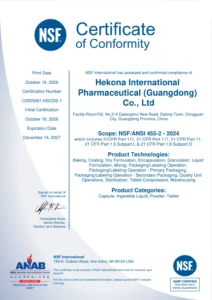
The official NSF/ANSI 455-2 listing for HEKONA identifies the facility and its listed manufacturing technologies and product categories.
This supports the assessment of the manufacturing quality system.
However, facility certification does not automatically mean that an individual D3 + K2 formula, label, health claim, or assigned shelf life has received separate product certification or approval.
Each commercial project still requires its own controlled documentation, including:
- Approved K2 commercial grade.
- Supplier and material identification.
- Micro-ingredient dispensing and reconciliation records.
- Approved master formula.
- Manufacturing and blending records.
- Finished-product specifications.
- Analytical testing.
- Stability documentation.
- Label review.
- Batch release records.
For a deeper explanation of how this facility-level certification relates to brand-owner supplier evaluation, see HEKONA’s article, What NSF/ANSI 455-2 Means for Supplement Brands
The important distinction is that a certification supports the facility and its assessed scope, while the product’s actual quality must be demonstrated through its own specifications, manufacturing records, testing, and release process.
11. What Should Brands Confirm Before Choosing MK-4 or MK-7?
Before requesting a commercial quotation or approving samples, brands should provide a clear development brief.
The following information helps the manufacturer evaluate the project more accurately.
Product and Market
- Intended sales market.
- Target consumer group.
- Product positioning.
- Planned product claims.
Formula
- Target vitamin D3 amount.
- Target vitamin K amount.
- Preferred K2 form: MK-4 or MK-7.
- Preferred ingredient source or brand, if applicable.
- Required active concentration.
- Carrier restrictions.
- Complete formula, if available.
Manufacturing
- Preferred capsule size.
- Target capsules per serving.
- Planned bottle count.
- Packaging configuration.
- Initial production quantity.
Quality and Testing
- Raw material specification requirements.
- Required identification and assay methods.
- Relevant isomer specifications.
- Finished-product testing requirements.
- Stability expectations.
- Certificate of Analysis requirements.
Label and Regulatory
- Target-market labeling requirements.
- Intended Supplement Facts declaration.
- Other Ingredients requirements.
- Proposed warnings and directions.
- Required source or branded-ingredient statements.
If both MK-4 and MK-7 are still under consideration, the two options should remain separate controlled formulation versions.
Each version should have its own:
- Ingredient grade.
- Material code.
- Active concentration.
- Batch calculation.
- Carrier contribution.
- Manufacturing assessment.
- Label review.
The unselected version should also be retained as a controlled development record. It may be useful if the brand later revisits the formulation or evaluates an alternative supplier.
An early comparison can reveal a dosage, serving-size, capsule-capacity, or packaging issue before artwork and purchasing commitments are finalized.
Conclusion: MK-4 and MK-7 Represent Different Formulation and Manufacturing Decisions
Choosing between MK-4 and MK-7 is not simply a matter of comparing two ingredient names or selecting the form with the most attractive marketing message.
For a commercial Vitamin D3 + K2 capsule, the decision affects several connected stages:
Dose rationale → Commercial ingredient grade → Active concentration → Carrier system → Low-dose blending → D3/K2 compatibility → Capsule fill weight → Finished-product stability → Labeling → Supplier change control
The key is to establish the intended dose and specific commercial material first, then maintain consistency across purchasing, production, quality control, finished-product release, and artwork.
A label may still show the same vitamin K amount after a supplier change, but the manufacturing formula behind that label may be substantially different.
For supplement brands, the more useful question is therefore not simply: “Which is better, MK-4 or MK-7?”
“Which specific commercial vitamin K2 grade is suitable for our target dose, complete formula, manufacturing process, stability requirements, and target market?”
That is the question a qualified contract manufacturer should help a brand answer before commercial production begins.
Frequently Asked Questions
- Can MK-4 be replaced with MK-7 at the same numerical dose?
Not by assumption. The two forms have different research backgrounds and pharmacokinetic characteristics. There is no universal dose-conversion ratio suitable for every commercial formulation. The dose rationale, ingredient grade, target market, and labeling should be reviewed before making the change.
- Why can two MK-7 materials require different manufacturing weights for the same 100 mcg target?
Because their active concentrations may differ. A 1% MK-7 premix theoretically requires 10 mg to provide 100 mcg of active MK-7, while a 0.2% premix requires 50 mg. The actual production calculation must also account for the approved assay basis and batch-specific requirements.
- Why does the carrier in an MK-7 premix matter?
The carrier contributes to the total material weight and can influence particle size, density, flow, blending behavior, and capsule fill requirements. It may also affect how the material is declared in the ingredient list, depending on its regulatory classification.
- Is MK-7 always a better choice than MK-4 for D3 + K2 capsules?
No universal conclusion can be made for every product. The choice should be based on the intended formulation, dose rationale, scientific evidence, commercial ingredient specifications, manufacturing requirements, stability, and target market.
- Why should an MK-7 supplier change trigger a formulation review?
Different suppliers may provide different active concentrations, carriers, particle sizes, density profiles, analytical methods, isomer specifications, and storage requirements. Even if the label remains unchanged, the manufacturing formula and process may need reassessment.
- Can an MK-7 supplier’s stability data establish a 24-month shelf life for the finished capsule?
Not automatically. Raw material stability data relate to the ingredient under specified conditions. The finished product also depends on the complete formulation, capsule shell, manufacturing process, packaging, and storage conditions. Finished-product shelf-life decisions require appropriate supporting evidence for the commercial product.


