

From market signals and human research to raw-material characterisation and commercial capsule production
Vitamin C is a well-established nutrient in the dietary supplement market. As products become more competitive, differentiation is no longer limited to the labelled dose, dosage form or price. Raw-material specifications, delivery systems and manufacturing quality are also becoming important parts of product development.
Liposomal vitamin C gives brands another formulation route to consider. However, the word “liposomal” alone does not establish the material’s structure, its actual vitamin C content or the performance of the finished product. Buyers need to ask more specific questions: How much active vitamin C does the powder contain? What phospholipids are used? How is encapsulation efficiency measured? In what sample state was particle size determined? Can the powder be filled consistently into the intended capsule? Will the finished product continue to meet its specifications throughout its shelf life?
This article reviews the market, scientific evidence, raw-material specifications and manufacturing considerations that brands should evaluate before purchasing liposomal vitamin C, approving label artwork or moving a capsule formula into commercial production.
1. Why Is Liposomal Vitamin C Receiving More Attention from Supplement Brands?
1.1 Competition is moving beyond the active ingredient alone
Conventional vitamin C products are already well established. For brands developing a differentiated product range, simply increasing the labelled vitamin C amount may not create a compelling point of difference. Some brands are therefore exploring liposomes, micelles, emulsions and other delivery systems as additional formulation options.
On 19 December 2025, the UK Committee on Toxicity, under the Food Standards Agency, published a report reviewing novel supplement formulations designed to increase oral bioavailability. The report discusses the growing use of different formulation approaches, including liposomes, micelles and emulsions, as well as other systems intended to influence the solubilisation, encapsulation, stability or absorption of active ingredients.
The report also included a preliminary online-marketplace search. The search term “liposomal supplements” returned 649 products from one popular online marketplace. The active ingredients in the first 105 products were then listed.
| Most frequently listed active ingredient | Number of products |
| Vitamin C | 54 |
| Vitamin B | 11 |
| Glutathione | 10 |
| NAD+ | 8 |
| Vitamin D3 | 6 |
| NMN | 5 |
Vitamin C was the most frequently represented single active ingredient in this sample. The limitations are important: this was a preliminary search of one online marketplace, not a global market-size or sales study. The report also noted that duplicate listings may have affected the results and that products containing multiple active ingredients were excluded. These figures are useful for observing product availability, but they should not be presented as consumer purchase rates, repeat-purchase rates or market share.
1.2 Liposomal products are appearing in broader retail channels
Retail announcements provide another market signal. In October 2025, US supplement brand Cymbiotika announced its nationwide launch at Target, with liposomal vitamin C included in the initial product range. In May 2026, the brand announced an expansion into selected Whole Foods Market stores. These are brand announcements showing wider retail distribution for that company; they do not, by themselves, establish category-wide sales growth.
Sources: Cymbiotika’s Target launch announcement; Cymbiotika’s Whole Foods Market announcement
1.3 Where is the commercial opportunity for a brand?
The commercial appeal of liposomal vitamin C can be considered from three angles:
- Consumers already recognise vitamin C, so a brand can build on an established nutrient while introducing the delivery system as an additional product distinction.
- The specification can include further technical dimensions, such as phospholipid composition, encapsulation characteristics, reconstituted particle size and structural characterisation.
- For brands developing a premium range, delivery technology may form part of the product positioning—but it needs to be supported by relevant ingredient data, appropriate scientific evidence and a consistent manufacturing process.
A more defensible market conclusion is not that consumers necessarily prefer liposomal vitamin C. Rather, the format has visible product availability and brand-level retail examples, creating a basis for further product development. Consumer acceptance and actual sales performance still need to be verified with brand-specific market data.
2. What Does the Science Say? Is Conventional Vitamin C Poorly Absorbed?

2.1 Conventional vitamin C already has good absorption at moderate intakes
Vitamin C is a water-soluble nutrient, and intestinal absorption is regulated by dose-dependent transport mechanisms. The US National Institutes of Health Office of Dietary Supplements reports that approximately 70% to 90% of vitamin C is absorbed at moderate intakes of 30 to 180 mg per day. At doses above 1 g per day, absorption falls below 50%. The body also regulates plasma and tissue vitamin C concentrations, and absorbed, unmetabolised vitamin C can be excreted in urine.
Conventional vitamin C should therefore not be described as generally poorly absorbed. The relevant research question for liposomal formulations is whether a particular formulation changes vitamin C pharmacokinetics under defined dose and study conditions.
Source: NIH Office of Dietary Supplements: Vitamin C Fact Sheet for Health Professionals
2.2 A liposome is a defined structure, not simply a phospholipid blend
Liposomes are generally vesicles formed from phospholipid bilayers. They contain an internal aqueous compartment surrounded by a phospholipid membrane. Because vitamin C is water-soluble, it can be incorporated into the aqueous region of a suitably designed liposomal system.
However, the presence of phospholipids or lecithin does not automatically demonstrate that intact liposomal vesicles have formed. Emulsions, micellar systems, phospholipid complexes and liposomes have different structural characteristics and should not be treated as interchangeable based on an ingredient name or a single phospholipid assay.
A 2024 review in Food Chemistry discusses food-liposome structure, phospholipid composition, preparation methods and stability. It notes that phospholipid type, formulation composition and preparation conditions can influence liposome structure and stability.
Source: Food Liposomes: Structures, Components, Preparations, and Applications

Figure 1. Conceptual illustration of liposomal vitamin C. The vesicles are shown for visual explanation and do not represent the measured size, morphology or microscopy results of a specific ingredient.
2.3 What has human research demonstrated?
A 2024 randomised, double-blind, placebo-controlled crossover trial included 27 adults (19 men and 8 women). Under fasting conditions, participants received placebo, 500 mg of conventional vitamin C or 500 mg of a specific liposomal vitamin C formulation. Blood samples were collected at multiple time points over 24 hours to measure vitamin C concentrations in plasma and leukocytes.
| Measurement | Difference reported for the specific liposomal formulation versus conventional vitamin C |
| Plasma vitamin C maximum concentration | 27% higher |
| Leukocyte vitamin C maximum concentration | 20% higher |
| Plasma concentration–time area under the curve | 21% higher |
| Leukocyte concentration–time area under the curve | 8% higher |
Compared with conventional vitamin C, the specific liposomal formulation tested in this trial produced a 27% higher plasma vitamin C Cmax, a 20% higher leukocyte Cmax, a 21% higher plasma AUC and an 8% higher leukocyte AUC. These are pharmacokinetic outcomes. They do not mean that total absorption increased by the same percentages, and they do not establish a corresponding improvement in clinical health outcomes. The study was small, used a single-dose design and evaluated one specific formulation; its results should not be assumed to apply to every commercial liposomal vitamin C ingredient.
Source: 2024 Human Randomised Controlled Study of Liposomal Vitamin C
2.4 What does the 2025 scoping review add?
A scoping review published in 2025 identified 321 records and included 10 human studies. Nine studies reported higher results for at least one pharmacokinetic measure with liposomal vitamin C than with non-liposomal controls. However, the formulations, doses and sampling periods varied substantially. Vitamin C doses ranged from 150 mg to 10 g, and sampling periods ranged from 4 to 24 hours.
The review also noted that none of the included studies assessed urinary vitamin C elimination; only two assessed in-vivo cellular uptake, and only two investigated potential biological effects. The magnitude of the reported pharmacokinetic differences varied and may relate to differences in liposomal formulations, doses, sampling periods and participants’ baseline vitamin C status. The review further reported that all 10 studies had industry funding and/or authors employed by companies.
One study-specific qualification is important. The original publication of the 27-person 2024 trial did not report participants’ baseline plasma vitamin C concentrations. The 2025 scoping review noted that, in subsequent communication with the study authors, baseline values were reported at approximately 0.9–1.0 μmol/L, a very low level. This information came from author correspondence rather than the primary paper’s published baseline data, so its source and evidence level should be made clear. Baseline status can affect interpretation and limits direct extrapolation to people whose vitamin C status is already adequate.
The current evidence supports further investigation of the pharmacokinetics of specific liposomal formulations. It does not establish that all commercial ingredients perform in the same way, nor does it justify converting pharmacokinetic differences directly into consumer health-outcome claims.
Source: 2025 Scoping Review: Do Liposomal Vitamin C Formulations Have Improved Bioavailability?
For brands, the key principle is that a human study must match the formulation, dose, comparator and endpoints actually tested. Two products labelled “liposomal vitamin C” are not necessarily equivalent in structure or supporting evidence.
3. What Should Brands Verify When Purchasing Liposomal Vitamin C?
Different liposomal vitamin C powders may vary in active content, phospholipid composition, carrier levels, manufacturing route and structural characteristics. Buyers should distinguish at least the following specifications.

Figure 2. Photograph of a liposomal vitamin C powder sample. It illustrates physical appearance only and does not verify the batch’s vitamin C assay, phospholipid ratio, encapsulation efficiency or liposomal structure.
3.1 Actual vitamin C content
First, confirm the actual vitamin C assay, analytical method, batch result and full ingredient composition. A raw material name containing “liposomal vitamin C” does not tell the buyer how much vitamin C is present in each gram of powder.
3.2 Phospholipid content and composition
Phospholipids are essential components of liposomal membranes, but total phospholipid content alone does not prove the presence of intact vesicles or establish encapsulation efficiency. Brands should confirm the phospholipid source, specific phospholipid types, total content and, where relevant, quantitative results for components such as phosphatidylcholine.
3.3 Encapsulation efficiency and free vitamin C
Encapsulation efficiency describes the proportion of total vitamin C classified as encapsulated under a defined analytical method. A commonly used expression is:
Encapsulation efficiency (%) = (Total vitamin C − Free vitamin C) ÷ Total vitamin C × 100%
This calculation is meaningful only when the method for separating free vitamin C, the total-content assay and recovery of the separation procedure have been appropriately established. Buyers should ask how free vitamin C is separated, how total vitamin C is measured, whether sample preparation affects the liposomal structure and whether the reported result represents the actual commercial batch.
3.4 Particle size, distribution and structural characterisation
Particle size is one parameter in liposome evaluation, but the test object and sample state must be clear. The particle size of a dry powder is not the same as the hydrodynamic size of vesicles after reconstitution. Dynamic light scattering can provide hydrodynamic particle-size and distribution data for a dispersion, but it cannot independently prove that the particles have a phospholipid bilayer structure.
A 2021 assessment by the UK Government Chemist examined a dispute involving a liposomal vitamin C product. It noted that dynamic light scattering and particle-tracking analysis can provide particle-size information but cannot independently establish particle identity or structure. Transmission electron microscopy findings can also be affected by sample preparation and laboratory quality controls. The assessment concluded that the evidence submitted by either party was insufficient, on its own, to prove the presence or absence of liposomes.
Source: Government Chemist Review 2021: Liposomal Vitamin C
3.5 The test report must identify the state of the sample
This is an important point that can be overlooked during raw-material review. Was the analyst measuring the original liquid dispersion, a dry powder reconstituted in water, a sample after a specified hydration period, or the final blend after other ingredients had been added? These sample states are not interchangeable.
For particle-size or structural testing, the technical file should, where relevant, state the reconstitution medium, sample concentration, temperature, hydration time, whether sonication was used and the interval between sample preparation and instrument measurement. Changes in sample preparation may change the reported particle-size distribution. The analytical method is therefore part of the result.
FDA’s guidance on liposome drug products discusses composition, particle-size distribution, morphology, drug-loading state, manufacturing controls and stability for liposomal drug products reviewed by FDA’s Center for Drug Evaluation and Research. It is a drug-product guidance, not a dietary supplement regulation. For supplement projects, it can only serve as a technical reference for thinking about complex lipid-system characterisation, not as a mandatory supplement test panel.
Source: FDA Guidance for Liposome Drug Products
If a brand plans to use “nano” wording in a label or marketing material, the proposed claim should be reviewed separately against the actual dimensional data, structure and intended wording. FDA’s nanotechnology guidance does not provide a simple universal classification for every product; it discusses dimensions and dimension-dependent properties in the context of specific products.
| Raw-material review area | What should be verified |
| Vitamin C content | Actual assay, analytical method and batch result |
| Phospholipid composition | Source, type, total content and relevant specific fractions |
| Encapsulation efficiency | Free-fraction separation, calculation and method validation |
| Particle size and distribution | Sample state, reconstitution conditions, mean size and distribution |
| Structural characterisation | Appropriate microscopy or other structural evidence |
| Powder properties | Moisture, bulk density, tapped density, flow and particle size |
| Stability | Changes in active content and relevant structural attributes over time |
4. From Raw-Material Assay to Label: How Much Powder Is Needed for 500 mg of Vitamin C?
During product development, the brand must first clarify whether the target dose refers to actual vitamin C content or the total weight of the liposomal premix. These are not the same measurement.
4.1 Example using a raw material containing 70% vitamin C
Assume a liposomal vitamin C powder has an actual vitamin C content of 70%. If the target is 500 mg of vitamin C per serving, the theoretical raw-material input is:
500 mg ÷ 70% = 714.3 mg of liposomal vitamin C powder
Approximately 714.3 mg of the premix is therefore required to provide 500 mg of vitamin C. The remaining material may include phospholipids and other carriers or excipients; the exact composition must be confirmed from the full raw-material specification.
| Vitamin C content of raw material | Theoretical raw material needed for 500 mg vitamin C |
| 70% | 714.3 mg |
| 75% | 666.7 mg |
| 80% | 625 mg |
| 85% | 588.2 mg |
These are theoretical calculations. Actual production quantities should be based on the approved raw-material specification, batch assay and manufacturing formula.
4.2 Keep three weights separate
| Weight | Meaning |
| Active vitamin C content | The target weight of vitamin C itself in the formula or label declaration |
| Liposomal raw-material input | The total premix weight calculated from the raw material’s actual vitamin C assay |
| Final capsule fill weight | The combined weight of the liposomal ingredient, other actives and excipients |
For example, 714.3 mg of liposomal vitamin C powder is only one part of the formula. If the product also contains zinc, vitamin E or other active ingredients, the final capsule fill weight will increase. Capsule size and serving count must be calculated from the complete formula, not from the vitamin C declaration alone.
4.3 The label declaration must match the actual active content
For US dietary supplements, the FDA Dietary Supplement Labeling Guide, Chapter IV, discusses the declaration of dietary ingredients and their amounts in the Supplement Facts panel. Brands should confirm the vitamin C declaration against the actual ingredient specification, analytical results and applicable labelling requirements. The total weight of a phospholipid-and-carrier premix should not automatically be treated as the active vitamin C amount. The exact ingredient name and source declaration should also be reviewed for the formula and destination market.
Source: FDA Dietary Supplement Labeling Guide: Chapter IV — Nutrition Labeling
For the U.S. market, 21 CFR 101.36(b)(2)(ii) further states that the quantitative amount declared for a dietary ingredient with an established Daily Value represents the weight of the dietary ingredient itself, not the weight of its source ingredient. For vitamin C, brands should therefore use the actual vitamin C content as the calculation basis rather than listing the total mass of a phospholipid complex as vitamin C. The exact label structure and ingredient statement still need to be reviewed against the complete formula.
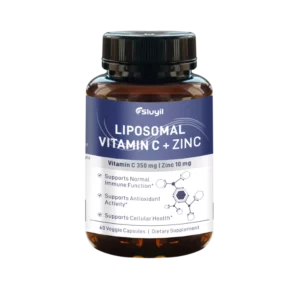
HEKONA’s current Liposomal Vitamin C + Zinc Capsules page provides a practical specification-review example. It lists 350 mg as the stated amount of a phospholipid complex and explicitly notes that the active vitamin C basis must be confirmed against the raw-material specification. The 350 mg figure should not be read as 350 mg of vitamin C. The supplier’s vitamin C assay, phospholipid and carrier composition, and the finished formula calculation must be reviewed before the final Supplement Facts basis is approved.
Related product: Liposomal Vitamin C + Zinc Capsules
5. Why May Liposomal Vitamin C Powder Be Difficult to Fill into Capsules?
A raw material that meets its chemical specification is not necessarily ready for direct capsule filling. For powder-based liposomal ingredients, physical properties can affect dosing, powder feeding, fill weight and manufacturing consistency.
5.1 Powder density affects the mass that fits into a capsule volume
Capsule size defines an internal volume; it does not establish a universal fill weight for every powder. Different powders can occupy different volumes at the same mass. The mass that fits into the same capsule volume can vary with bulk density, particle characteristics and packing behaviour.
5.2 Flowability and cohesion affect dosing consistency
| Powder characteristic | Potential manufacturing relevance |
| Bulk density | Influences the mass occupying a given volume |
| Tapped density | Shows how powder volume changes after mechanical tapping |
| Particle-size distribution | May influence blending, segregation and feeding behaviour |
| Flowability | Affects consistency as powder enters the dosing mechanism |
| Cohesion | May contribute to bridging, agglomeration or uneven feeding |
| Moisture content | May influence caking, flow and storage behaviour |
| Compressibility | Influences packing during dosing and tamping |
A 2013 study in Drug Development and Industrial Pharmacy investigated the relationship between powder-flow properties and capsule fill-weight uniformity using a continuous capsule-filling machine. The researchers found significant correlations between the physical properties of final powder blends and capsule weight and weight variability. The study was not specific to liposomal vitamin C, but it provides relevant evidence for evaluating powder-based capsule formulations.
Source: Effects of Powder Flow Properties on Capsule Filling Weight Uniformity
USP General Chapter 616 describes methods for determining bulk and tapped density of powders and can be used as a reference for powder-property evaluation.
Source: USP General Chapter 616: Bulk Density and Tapped Density of Powders
5.3 Capsule size 00 should not be approved from a theoretical weight alone
Assume a formula requires 714.3 mg of liposomal vitamin C powder. If the formula also contains other actives and excipients, the total fill weight may be considerably higher. Even if the calculated weight appears close to a nominal capsule capacity, this does not establish that the formula can be filled consistently.
Actual fill feasibility depends on bulk density, flowability, equipment dosing design, tamping conditions and the internal volume of the selected shell. HEKONA’s Size 0 vs. Size 00 capsule guide discusses the trade-offs among capsule volume, serving count and consumer swallowing experience.
5.4 Conduct filling trials before commercial production
- Measure bulk and tapped density, and evaluate powder flow and cohesion.
- Confirm moisture, particle-size distribution and physical condition after storage.
- Calculate the total fill weight of the complete formula, not only the vitamin C ingredient.
- Run filling trials using the intended capsule shell and production equipment.
- Check powder feeding, average fill weight, weight variation, capsule locking and appearance.
- Use the trial results to assess whether the excipient system, pre-blending approach or an appropriate powder-processing step needs adjustment.
Any process adjustment intended to improve flow or fill weight must also be assessed against the quality attributes and stability requirements of the liposomal system.
6. From Powder Processing to Capsule Production: Which Process Factors Need Control?
6.1 Drying may affect liposomal structure
Some liposomal ingredients are converted from liquid dispersions into powders through processes such as spray drying. When spray drying is used, heat, shear forces and dehydration may affect vesicle structure, particle size and encapsulation characteristics. The selection of carriers and protective excipients may also influence reconstitution behaviour and powder properties.
A 2025 review in Food Science & Nutrition discusses liposomal formulation, processing and applications in food systems. It notes that spray-drying conditions and carrier selection may influence liposomal structure and encapsulation efficiency. Not all commercial liposomal powders use the same drying process, so the assessment must be based on the actual manufacturing route of the material.
Source: Liposomal Encapsulation in Food Systems: A Review of Formulation, Processing, and Applications
6.2 Distinguish upstream ingredient manufacture from downstream capsule manufacture
Liposomal structure may change during upstream preparation, drying and reconstitution. Once the ingredient reaches the capsule manufacturer, it may undergo weighing, pre-blending, final blending, transfer, filling and packaging. A particle-size or structural result obtained from a supplier’s liquid intermediate does not automatically describe the dry powder, final blend or finished capsule.
The technical file should identify the process stage represented by each test result. Depending on the product claim and risk assessment, relevant attributes may need to be checked again after drying, blending or in the finished product.
6.3 Mixing, environment and packaging do not have universal setpoints
A liposomal vitamin C project may require evaluation of mixing time, mixing intensity, material-transfer methods, ambient humidity, powder exposure time and excipient compatibility. There is no single temperature, humidity or mixing-time setting that applies to every liposomal powder. Parameters should be established from the raw-material requirements, development trials and relevant process validation.
During development, these variables can be translated into documented and reviewable process conditions, such as the actual temperature and relative-humidity range, material opening and exposure time, blender type and load, mixing time and intensity, transfer method, hold time before packaging, and the package seal and desiccant configuration. These are project-specific factors to evaluate when establishing process controls, not universal numerical setpoints.
Where specialised premixing or powder pre-processing is needed, the process should be checked to ensure that it does not compromise relevant liposomal quality attributes. See HEKONA’s Customized Dietary Supplement Premix Solution for information about formulation pre-processing and manufacturing handoff.
6.4 Packaging and storage are part of finished-product stability
Vitamin C stability may be affected by oxygen, moisture, light, temperature and other ingredients in the formula. Phospholipid systems also require consideration of oxidation, hydrolysis and storage conditions. Packaging material, closure, barrier properties, desiccant selection and storage conditions should therefore be assessed for the actual formula.
A raw-material shelf life cannot replace finished-product stability data. The finished-product study should, where possible, use the actual commercial formula and final packaging. Depending on the product, relevant attributes may include vitamin C content, moisture or water activity, capsule appearance and integrity, disintegration, and liposomal-related structural attributes when they are material to the product specification.
7. Finished-Product Quality Control: A Qualified Raw Material Does Not Automatically Mean a Qualified Finished Product
A supplier’s certificate of analysis primarily describes the incoming raw-material lot. After receipt, the material goes through weighing, blending, filling, packaging and finished-product release. A raw-material COA, supplier characterisation report, pilot-batch record and finished-product COA answer different questions and cannot replace one another.
| Quality document or record | Main question it can answer |
| Raw-material specification and supplier COA | What material was received, and did the lot meet the listed raw-material specifications? |
| Supplier characterisation report | What particle-size or structural characteristics were observed under the stated sample-preparation and test conditions? |
| Pilot and batch records | Could the approved material and formula be weighed, blended, transferred and filled as planned? Were process deviations recorded? |
| Finished-product testing and stability data | Does the finished capsule continue to meet approved specifications in its commercial package and under the stated storage conditions? |
7.1 What does US dietary supplement GMP require?
Under 21 CFR 111.70, dietary supplement manufacturers must establish appropriate component specifications, in-process specifications, finished-product specifications, and specifications for packaging and labels. Finished-product specifications address identity, purity, strength, composition and limits for contaminants. These specifications should connect to the approved master manufacturing record and the controls used in production.
In addition, 21 CFR 111.205 requires a written master manufacturing record for each unique formulation and batch size, identifying the process stages where control is necessary and the procedures used to ensure each batch meets its specifications. 21 CFR 111.75 addresses how manufacturers determine whether specifications are met, including dietary-ingredient identity verification, conditions for relying on supplier COAs, in-process monitoring and finished-product specification verification. The rule allows verification of a subset of finished-product specifications under a sound statistical sampling plan, or verification of every finished batch; it should not be misrepresented as requiring every possible test on every batch.
Source: 21 CFR 111.70: What Specifications Must You Establish?
7.2 Finished-product testing should reflect the actual formula and risk
A quality plan for liposomal vitamin C capsules may consider vitamin C assay, ingredient identity, relevant contaminants, microbiology, capsule fill weight, disintegration, package integrity and stability. If the product positioning specifically relies on liposomal structure, the team should assess whether reconstituted particle-size or structural characterisation is needed in the finished product or during stability testing.
This does not mean that every possible test is a fixed mandatory panel for every product. The test plan should be based on the formula, raw-material characteristics, product specifications, destination-market requirements and suitability of the analytical methods.
HEKONA’s Raw Material Sourcing and Quality Control, Laboratory Testing Capabilities and Finished Product Assurance pages describe the relevant stages of incoming-material review, testing support and finished-product quality management.
7.3 Finished-product stability should represent the commercial product
The finished capsule differs from the original raw material in formula composition, processing history, shell, packaging and storage conditions. A raw-material stability report alone cannot establish a 24-month shelf life for the finished capsule. An appropriate stability programme should use the actual commercial formula and final packaging, with test points and quality attributes selected according to product risk.
When reviewing COAs, brands should also distinguish a supplier’s raw-material COA from the COA for the finished batch. See HEKONA’s article: Supplier COA vs. Finished-Product COA: What Supplement Brands Should Verify Before Batch Release.
8. What Should Brands Confirm Before Approving a Liposomal Vitamin C Capsule Project?
Before placing a commercial order, brands should review the project across raw materials, formulation, manufacturing and quality.
| Review area | Questions to resolve |
| Raw-material composition | Is the complete ingredient composition and the amount of each component documented? |
| Active content | How much vitamin C is present per gram, and which analytical method is used? |
| Phospholipid system | Are the source, type and content of phospholipids clear? |
| Encapsulation efficiency | How is the free fraction separated, and can the method and result be traced? |
| Liposomal structure | Is there suitable structural evidence, and which process stage does the sample represent? |
| Particle size and distribution | Are reconstitution conditions, test method and particle-size distribution reported? |
| Powder properties | Are density, flowability, moisture and particle size suitable for capsule filling? |
| Label design | Does the declared amount refer to active vitamin C or total premix weight? |
| Capsule specification | Can the complete formula fit the target capsule, and have filling trials been completed? |
| Finished-product quality | Are finished-product testing, batch records and stability plans established? |
| Packaging | Is the selected package suitable for the formula and proposed storage conditions? |
These checks are not intended to make procurement unnecessarily complicated. They help identify technical issues during development, before a commercial order requires a formula, capsule size, package or label to be changed.
9. Frequently Asked Questions
1. What is the difference between liposomal vitamin C and conventional vitamin C?
The main difference is the formulation structure and delivery system. Conventional vitamin C is generally supplied as free ascorbic acid, while liposomal vitamin C uses a phospholipid bilayer vesicle system to carry vitamin C. Some human studies have reported differences in pharmacokinetic measurements for specific liposomal formulations, but products vary in composition and manufacturing process, so results cannot be assumed to apply to every liposomal ingredient.
2. Is liposomal vitamin C always better absorbed than conventional vitamin C?
No universal conclusion can be made. Some human studies report higher plasma or leukocyte vitamin C measurements for specific liposomal formulations, but the results depend on the ingredient composition, dose and study design. Brands should review the data for the specific raw material they plan to use rather than borrowing claims from another brand’s ingredient study.
3. Does 70% vitamin C content mean 70% encapsulation efficiency?
No. Vitamin C content is the proportion of the raw material’s weight that is vitamin C. Encapsulation efficiency is the proportion of total vitamin C classified as encapsulated under a defined analytical method. They are separate specifications and need to be evaluated separately.
4. Does higher phospholipid content or a smaller particle size automatically mean a better liposome?
Not necessarily. Phospholipid content, particle size, particle-size distribution and liposomal structure describe different characteristics. A higher phospholipid result does not independently prove intact vesicles, and a smaller particle size does not automatically demonstrate better encapsulation. Buyers should review phospholipid composition, encapsulation efficiency, reconstituted particle size, distribution and appropriate structural evidence together.
5. Can a size 00 capsule hold 500 mg of active vitamin C from a liposomal powder?
The raw-material input must first be calculated from the actual vitamin C assay. For example, a 70% ingredient requires approximately 714.3 mg of powder to provide 500 mg of vitamin C. Other actives and excipients increase the final fill weight. Whether the formula fits into one size 00 capsule must be confirmed through powder-density and flow assessment and actual filling trials.
6. Can a supplier’s stability report establish a 24-month shelf life for the finished capsule?
Not by itself. The finished capsule has a different composition, manufacturing history, shell, package and storage environment from the raw material. Stability should be evaluated using the actual commercial formula and final packaging before assigning the finished-product shelf life.
10. Choosing a Liposomal Vitamin C Capsule Manufacturer: Price Is Only One Part of the Decision
Liposomal vitamin C gives supplement brands another product-development option, but successful commercialisation depends on the coordination of raw-material quality, formulation design, label accuracy, manufacturing suitability and finished-product quality control.
A capable manufacturing partner should help review the raw-material specification, calculate active vitamin C content, assess phospholipid and excipient composition, evaluate the intended capsule size, check powder compatibility with production equipment and define the finished-product testing and stability requirements.
HEKONA INTERNATIONAL PHARMACEUTICAL (GUANGDONG) CO., LTD. provides contract manufacturing services for overseas supplement brands across capsules, tablets, powders and other dosage forms. For specialised ingredient projects, we focus on the connection between raw-material review, formulation assessment, sample development and production feasibility.
Our quality-management activities cover incoming-material review, in-process controls, finished-product testing and batch traceability. Where specialised structural characterisation is required, the analytical method and laboratory capability should be confirmed for the project. Routine assay testing or ordinary powder particle-size testing should not be presented as a substitute for liposomal structural analysis.
HEKONA is listed in the official NSF/ANSI 455-2 directory for dietary supplement GMP facilities. The listed manufacturing technologies and product categories include capsules, powders, tablets and ingestible liquids. This is facility-level listing information; it does not mean NSF certifies a specific liposomal formula, vesicle structure, bioavailability claim or product shelf life.
Source: NSF/ANSI 455-2 Official Listing: HEKONA
Explore HEKONA’s related services:
- Capsule Manufacturing
- Raw Material Sourcing and Supply-Chain Quality
- Laboratory Testing Capabilities
- Finished Product Assurance
- Customized Dietary Supplement Premix Solution
- Liposomal Vitamin C + Zinc Capsules
If you are developing a liposomal vitamin C capsule, share your target vitamin C content, raw-material specification, capsule size, bottle count and destination market with our team. We can review the formula requirements and manufacturing feasibility to help complete the necessary technical checks before commercial production.
A commercially viable supplement needs more than an attractive ingredient specification. It needs verifiable technical data, a workable manufacturing process and consistent finished-product quality.
Research and Regulatory References
The following references support the market observations, scientific discussion, raw-material characterisation, powder evaluation and quality requirements in this article. Their scopes differ. In particular, FDA’s liposome drug-product guidance applies to the relevant drug-product review context and should not be interpreted as a dietary supplement regulation.
- UK Committee on Toxicity / Food Standards Agency: Novel Formulations of Supplement Compounds Designed to Increase Oral Bioavailability
- NIH Office of Dietary Supplements: Vitamin C Fact Sheet for Health Professionals
- 2024 Human Randomised Controlled Study of Liposomal Vitamin C
- 2025 Scoping Review of Liposomal Vitamin C Bioavailability
- Food Liposomes: Structures, Components, Preparations, and Applications
- Liposomal Encapsulation in Food Systems: A Review of Formulation, Processing, and Applications
- Government Chemist Review 2021: Liposomal Vitamin C
- USP General Chapter 616: Bulk Density and Tapped Density of Powders
- Effects of Powder Flow Properties on Capsule Filling Weight Uniformity
- FDA Dietary Supplement Labeling Guide: Chapter IV — Nutrition Labeling
- 21 CFR 111.70: What Specifications Must You Establish?
- FDA Guidance for Liposome Drug Products
- FDA Guidance on Nanotechnology in FDA-Regulated Products
- Cymbiotika’s Target Launch Announcement
- Cymbiotika’s Whole Foods Market Announcement
- 21 CFR 101.36: Nutrition Labeling of Dietary Supplements
- 21 CFR 111.205: Master Manufacturing Record
- 21 CFR 111.75: Determining Whether Specifications Are Met


