

Two suppliers both quote “magnesium glycinate.” Why can one formulation stay within a practical capsule count while another needs more capsules – or becomes difficult to run consistently on an automatic capsule filler?
Open the two supplier files. One grade may be buffered; the other may not. Their elemental assays, densities, and flow notes may also be different. A shared ingredient name does not make those powders interchangeable on the filling line.
Approve the grade first. Capsule count, bottle count, artwork, and price can follow.
Read glycinate and bisglycinate as names, not as finished purchasing specifications. Both may describe the same magnesium-glycine chelate, with bisglycinate spelling out the two glycine ligands. The supplier code and the controlled specification tell the factory what it is actually buying.
On Hekona’s Magnesium Bisglycinate capsule product, the declared magnesium amount refers to elemental magnesium. The actual magnesium bisglycinate material weighed in production is necessarily heavier than that label value.
1. Separate the Three Different “Milligram” Numbers
One of the most common magnesium-project mistakes is using the word “magnesium” for three different quantities.
| Number | What It Actually Means |
| Elemental magnesium | The nutrient amount declared on the finished label. |
| Magnesium compound input | What production weighs after the grade and its elemental assay have been approved. |
| Total capsule fill | What remains inside the shell after the rest of the formula is added. |
Keep the label number and the scale number in separate boxes. A U.S. Supplement Facts panel uses elemental magnesium; production weighs the magnesium compound. The NIH Office of Dietary Supplements – Magnesium Fact Sheet for Health Professionals explains the label value in more detail.
Write 200 mg in the elemental box. If the accepted grade is 14%, the calculation points to about 1,429 mg of raw material per serving. Change the grade to 10%, and the input becomes 2,000 mg. The shell still has to accommodate every other ingredient as well.
Now the problem with a request for ‘200 mg magnesium’ is visible. Which of the three numbers does it mean: elemental magnesium, compound input, or complete capsule fill? A quotation should not leave the buyer to guess.
2. “Glycinate” vs “Bisglycinate” Is Not the Most Important Purchasing Question
Commercial naming is not always used consistently. A supplier may sell “magnesium glycinate,” “magnesium bisglycinate,” or “magnesium bisglycinate chelate,” while the manufacturing behavior of those commercial grades can still differ substantially.
For brand owners, the first technical review should therefore open the supplier file and confirm:
- Exact chemical/material form and supplier code
- Elemental magnesium assay and calculation basis
- Whether the material is buffered or contains another magnesium source
- Carrier or processing aids, if any
- Moisture specification
- Particle-size profile
- Loose and tapped density
- Flow and compaction behavior
- Identity and assay methods
- Storage and retest requirements
Hekona’s Raw Material Sourcing and Quality Control process ties supplier approval, material specification, incoming review, and batch traceability to the actual commercial material – not just a familiar ingredient name.
3. Pure Chelated vs Buffered Grades Can Change the Entire Capsule Design
At this point, two products with almost identical front-label wording can split into different manufacturing jobs.
Put an unbuffered chelate beside a buffered grade that also contains magnesium oxide. The buffered option may show more elemental magnesium per gram, so it can reach the target with less powder. That is useful for space, but it is also a different composition.
If the approved brief says pure chelate, unbuffered, or no magnesium oxide, stop there. A smaller fill does not make the buffered grade an acceptable substitute.
4. Put the Powder Beside the Capsule Chart
The chart knows the empty volume of the shell. It has never seen this powder leave a hopper, bridge above a feed point, or miss a target weight after a line stop.
Watch the actual dosing sequence instead. Does the material enter the chamber, compact in a repeatable way, and release without constant correction? Loose density and tapped density help explain the result, but particle size, cohesion, static, moisture, and compaction can change it.
Same elemental assay, same shell, same machine – and still a different fill result. The commercial grade is the variable that a generic capacity chart cannot capture.
Hekona’s existing Capsule Size 0 vs 00 guide explains the same principle from the shell-selection side: size 00 provides roughly 0.95 mL of reference volume, but milligrams cannot be predicted from shell size alone. The final blend must be tested.
5. A Real B2B Pain Point: 500 mg Pure Chelated Magnesium in One Size 00 Capsule
Hekona has repeatedly received briefs asking for a size 00 capsule containing 500 mg of pure chelated magnesium glycinate per capsule, with no magnesium oxide added.
Five hundred milligrams sounds safe when it is compared only with a generic size 00 capacity figure. Then the trial begins. A light or cohesive chelate may feed slowly, leave a dosing cavity partly filled, or require repeated adjustment. Empty shell volume was never the only limit.
Typical manufacturing symptoms can include:
- incomplete dosing-cavity fill
- intermittent or inconsistent powder feed
- low achieved net fill
- wider fill-weight variation
- reduced line speed
- more rejects or repeated machine adjustments
This is an important distinction for brands: the issue is not always “the capsule is too small.” Sometimes the raw-material grade is not suitable for the intended commercial filling process.
6. Why a Manufacturer May Propose Magnesium Oxide – and Why That May Still Be the Wrong Brand Solution
When three requirements are combined – high magnesium target, few capsules per serving, and a low-elemental-magnesium chelate – the powder burden can become difficult. A manufacturer may therefore propose a buffered system that includes magnesium oxide.
That recommendation is not necessarily only about raw-material cost. It may also reduce total powder mass and improve the feasibility of the capsule design. However, if the brand’s positioning requires a pure chelated, unbuffered formula with no magnesium oxide, the buffered route does not satisfy the original product brief.
The better technical question becomes: can a different pure-chelate commercial grade provide the required chemistry and a more manufacturable powder profile?
7. Why a High-Density Pure-Chelate Grade Can Change the Answer
Hekona recently evaluated a magnesium glycinate dihydrate commercial grade with the following batch results:
| Measured parameter | Batch result |
| Magnesium (dry basis) | 14.0% |
| Tapped density | 0.96 g/mL |
Do not merge the 14.0% result with the 0.96 g/mL result. The first one drives the elemental-magnesium calculation. The second one gives the team a rough idea of settled volume before a capsule is filled.
The arithmetic is simple: 500 mg divided by 0.96 g/mL is about 0.52 mL. A common reference volume for size 00 is about 0.95 mL. That leaves enough reason to run a trial, not enough reason to approve production.
In Hekona’s internal filling work with this specific commercial grade and defined equipment conditions, the practical size 00 fill reached close to 980 mg. That result should be understood as a grade- and process-specific manufacturing observation – not a universal fill-weight claim for every magnesium bisglycinate powder or every size 00 capsule.
For any public claim that a material is “pure chelated” or “magnesium-oxide free,” the supplier composition/specification file should support that statement. Assay and density data alone do not prove the absence of another magnesium source.
8. Brands Should Compare Manufacturability, Not Just Purity or Price per Kilogram
Assume two commercial grades both meet the brand’s chemistry and labeling requirements.
| Decision Point | Grade A | Grade B |
| Elemental magnesium | Comparable | Comparable |
| Powder density | Lower | Higher |
| Flow/metering | More difficult | More stable |
| Practical fill weight | Lower or variable | Potentially higher |
| Capsules per serving | May increase | May remain lower |
| Must be pilot filled? | Yes | Yes |
A cheaper bag of powder can produce a more expensive bottle. Add another capsule, slower machine time, rejects, a larger container, or rework, and the saving per kilogram may be gone. Compare the route that can be repeated, not the raw-material quote in isolation.
9. Let the Approved Powder Earn Its Shell Size
The Capsule Manufacturing process follows the work from weighing and blending through filling, in-process inspection, and finished-product testing. For this order, each step must still refer to the same commercial magnesium grade.
If the supplier grade is still open, the shell size is still open. Run the intended formula first. Otherwise, a late change can turn one capsule into two after the quotation, bottle, and artwork have already been approved.
10. The Label Still Comes Back to Elemental Magnesium
The Supplement Facts panel and the batch record should not repeat the same number by habit. The panel reports elemental magnesium in the serving. The batch record states how much of the approved compound was weighed to provide it.
FDA’s Dietary Supplement Labeling Guide – Chapter IV: Nutrition Labeling explains the nutrient-declaration framework for dietary supplements.
A controlled magnesium project should therefore connect:
- Target elemental magnesium
- Approved raw-material assay
- Calculated material input
- Observed capsule fill
- Capsules per serving
- Servings per container
- Final Supplement Facts and ingredient wording
11. A COA Ends at the Questions It Actually Answers
Use the COA for the incoming checks printed on it: identity, assay, moisture, density, heavy metals, or microbiological limits, as applicable. It cannot show whether the finished blend will feed for an entire commercial run. That answer belongs to the fill trial and production record.
That is why Raw Material Sourcing and Finished Product Assurance serve different roles. Incoming qualification answers “what material did we receive?” Pilot filling and finished-product controls answer “can this approved material be reproduced as the intended commercial product?”
12. NSF/ANSI 455-2 Supports the Manufacturing System – Not Automatic Product Certification
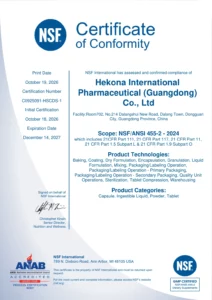
Hekona’s current NSF listing identifies the facility under NSF/ANSI 455-2 and includes capsules within the listed product categories, together with manufacturing activities such as mixing, encapsulation, packaging/labeling, quality-unit operations, and warehousing. View the NSF facility listing
File the listing with facility and quality-system evidence. Do not turn it into automatic product certification. The magnesium formula still needs its own approved material, calculation, batch documents, testing, artwork review, and release.
13. What a Brand Should Tell the Manufacturer Before Requesting a Quote
Before asking for a firm quote, replace ‘500 mg, size 00, one capsule’ with a brief that production can actually use. Confirm:
- which 500 mg is intended – elemental magnesium or raw-material weight
- Whether the formula must be pure chelated/unbuffered
- Whether magnesium oxide or any other magnesium source is prohibited
- Target elemental magnesium per serving
- Maximum acceptable capsules per serving
- Preferred capsule size and any swallowability constraint
- Full formula, including other actives and excipients
- Target market
- Bottle count and desired servings per container
- whether a different commercial grade may be qualified if the first grade does not run as planned
Those answers give the manufacturer enough to judge the real order. The question is no longer whether a few numbers fit in a spreadsheet; it is whether the selected materials can be filled the same way batch after batch.
Conclusion: The Commercial Grade Matters More Than the Shorthand Name
For capsule brands, “magnesium glycinate” versus “magnesium bisglycinate” is usually not the most useful manufacturing comparison. The commercial grade behind the name is what determines the formulation outcome.
A workable magnesium capsule connects elemental magnesium percentage, chelate/buffered status, other magnesium sources, powder density, flow and compaction behavior, real machine fill performance, serving count, bottle configuration, and final labeling.
Hekona’s experience with 500 mg pure-chelate size 00 projects illustrates the key lesson: having enough theoretical capsule volume does not guarantee stable commercial filling. At the same time, a difficult first trial does not necessarily mean the product concept is impossible – a more suitable commercial raw-material grade can change the manufacturing answer.
For a brand owner, the most useful question is therefore not simply “Is this magnesium glycinate?” It is: “Which exact commercial grade will you use, and how does it actually perform in the capsule and equipment planned for my product?”
FAQ
Are magnesium glycinate and magnesium bisglycinate completely different ingredients?
Usually not. In many commercial and database naming contexts, both names can refer to the same core magnesium-glycine chelate. “Bisglycinate” is the more structurally specific name. Purchasing should still be based on the exact supplier specification and commercial grade.
Why can 500 mg of pure magnesium glycinate be difficult to run in a size 00 capsule?
Because capsule filling depends on more than theoretical shell volume. A low-density, cohesive, or poorly flowing powder may not meter consistently enough to achieve the target fill on automatic equipment. Pilot filling is required.
What is the difference between buffered and unbuffered magnesium bisglycinate?
A buffered commercial grade may combine magnesium bisglycinate with another magnesium source such as magnesium oxide. That can increase the overall elemental-magnesium percentage and reduce total powder mass. If the brand excludes magnesium oxide, the approved raw-material specification must reflect that requirement.
Does higher density always mean more powder can be filled?
Higher density generally means that the same mass occupies less volume, which can improve fill-weight potential. But actual performance also depends on flow, compaction, particle size, the complete formulation, and machine settings.
Can 200 mg elemental magnesiu m fit into one size 00 capsule?
Not by judging the 200 mg label number alone. If the commercial grade contains about 14% elemental magnesium, roughly 1.43 g of that raw material would be needed to deliver 200 mg elemental magnesium before adding any other ingredients. The final capsule design therefore depends on the specific grade and serving structure.
What should be rechecked after changing the magnesium supplier or grade?
At minimum, recheck elemental-magnesium assay, composition, raw-material input calculation, density and flow, pilot-fill performance, capsules per serving, bottle count, quotation, and any affected label or packaging files.
Related Hekona resources: Magnesium Bisglycinate Capsules | Raw Material Sourcing | Capsule Manufacturing | Capsule Size 0 vs 00 | Finished Product Assurance


