
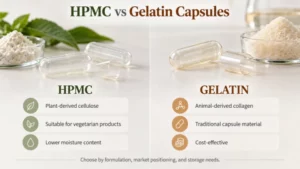
The choice between vegetable vs gelatin capsules should begin with the formula and the customer you intend to serve. A vegetable capsule, usually made from hypromellose or HPMC, supports plant-based positioning and can be useful for moisture-sensitive or gelatin-reactive fills. A gelatin capsule remains a familiar, widely used option and is often the more economical starting point when the formula and market have no material restriction.
Neither shell is automatically better. A private label brand should compare origin, moisture behavior, crosslinking risk, dissolution profile, target claims, certification needs, machinability, supplier documentation, and landed cost. The final decision belongs in the product specification and stability plan, not just in a marketing brief.
Vegetable vs Gelatin Capsules at a Glance
The table below is a decision guide, not a substitute for a shell supplier’s current technical specification.
| Decision Point | Vegetable / HPMC Capsule | Gelatin Capsule | Brand Question |
| Main shell origin | Cellulose-derived, plant-based | Animal-derived protein | What does the target market expect? |
| Moisture profile | Typically lower for cited HPMC systems | Typically higher for cited gelatin systems | Is the fill hygroscopic or moisture-sensitive? |
| Crosslinking | HPMC is not subject to gelatin crosslinking | Certain reactive fills can crosslink gelatin | Does the formula contain reactive aldehydes or extracts? |
| Release | Often immediate release; specialized versions vary | Commonly immediate release; specialized versions vary | What dissolution profile is actually required? |
| Positioning | Vegetarian or plant-based potential | Traditional and familiar | Which claims can the selected shell documents support? |
| Cost | Often carries a premium | Often the lower-cost baseline | What is the verified quote at the required volume? |
Start With the Formula, Not the Label Claim
Brands often begin the vegetable vs gelatin capsules discussion with a simple request: “We want vegan,” or “Use the cheapest shell.” Both requests can be commercially valid, but neither is enough to release a product for production.
Moisture Moves Between the Fill and the Shell
Capsule shells and their contents share a small moisture environment. A hygroscopic fill can draw water from its surroundings and, depending on the system, from the shell. A very dry environment can also change shell flexibility. This is why the formulation team needs the water activity or moisture behavior of the complete blend, not just the ingredient names.
Gelatin Crosslinking Is a Formula Question
Gelatin can crosslink under certain chemical conditions, which may delay disintegration or dissolution. Botanical extracts, flavor components, or other materials containing reactive aldehydes deserve particular review. The correct response is not to reject every gelatin capsule. It is to identify the risk, test the proposed combination, and decide whether formulation control, another gelatin specification, or HPMC is the more robust route.
Formulations containing aldehydes or other compounds that may promote cross-linking deserve particular attention when selecting a capsule shell. Gelatin capsules can undergo cross-linking under certain conditions, which may affect disintegration or dissolution, whereas HPMC capsules do not exhibit the characteristic cross-linking associated with gelatin shells.
For this reason, a private label or dietary supplement specification should not rely on the broad term “vegetable capsule” alone. The shell material, supplier specification, formulation compatibility, and dissolution performance should be evaluated together when deciding whether HPMC, gelatin, or another capsule type is the more appropriate option.
HPMC Is Not Automatically Enteric
One of the most common sourcing errors is treating all vegetable capsules as delayed release. Standard HPMC capsules can be designed for immediate release. Enteric or acid-resistant performance requires a shell or coating designed and tested for that purpose.
Hekona’s capsule manufacturing options list vegetarian, gelatin, enteric-coated, sustained-release, pullulan, and other capsule types separately. That separation matters. If a product needs release beyond the stomach, the requirement should be written as a dissolution profile with test conditions, not assumed from the word “vegetable.”
Consumer Positioning and Label Implications
Shell origin can influence who will consider the product, but the claims on the label must match the supplier documents.
Vegetarian, Vegan, Halal, and Kosher Are Not Synonyms
HPMC is plant-derived and can support vegetarian or vegan positioning when the complete capsule system and processing aids meet the claim. That does not automatically establish halal, kosher, allergen-free, non-GMO, or organic status. Each claim needs the relevant supplier declaration or certification and must account for colors, opacifiers, printing inks, and other shell components.
Gelatin is animal-derived. Its source may be bovine, porcine, fish, or another approved material. The source and certification can matter greatly to religious, cultural, and dietary audiences. A purchase order that says only “gelatin capsule” leaves an avoidable gap.
Color and Opacity Also Need Review
Clear shells reveal the fill and can reinforce a simple, natural appearance, but they also expose color variation. Opaque shells can mask an unattractive powder and create stronger brand recognition. Any pigment or opacifier must fit the destination market and the brand’s clean-label promise.
Ask for the complete shell composition, color standard, print specification, and regulatory documentation before artwork is finalized. Changing from gelatin to HPMC late in the project may alter appearance, supplier lead time, machine settings, and label language.
Claims Should Follow the Finished Specification
If a brand intends to use “veggie capsules” on the front panel, the shell specification and finished-product record should support that wording. If the product is reformulated or a substitute shell is used during a later batch, the change-control process should check whether the claim remains accurate.
Manufacturing, Cost, and Supply Considerations
Shell selection affects more than consumer perception. It also influences sourcing, filling behavior, inspection, packaging, and reorder risk.
Confirm Machine and Tooling Fit
Both shell types are available in standard sizes, but the exact supplier specification must fit the filling machine and tooling. The production team should review separation, orientation, dosing, locking, rejection, and polishing performance during the pilot run. A shell that performs well in a small hand-filled sample still needs to run reliably on the intended commercial line.
Hekona currently lists sizes 1, 0, and 00 and both vegetarian and gelatin options on its capsule page. A buyer should ask which supplier and grade will be used for the approved sample and whether the same specification will be available for repeat production.
Compare Total Cost, Not Shell Price Alone
Gelatin is often quoted below HPMC, but the shell price is only one line in the cost model. A lower-priced shell can become expensive if it conflicts with the formula, excludes an important customer segment, requires stronger environmental control, or creates avoidable rejects. HPMC can also be poor value if the formula gains no technical or positioning benefit from it.
Compare the finished cost per saleable bottle, including shell, processing, rejects, testing, packaging, lead time, and minimum purchase requirements. Ask the supplier to separate confirmed costs from estimates so the team can see what changes at commercial scale.
Validate Packaging and Stability Together
The bottle, liner, desiccant, blister, or pouch controls the environment around the finished capsule. A shell decision cannot compensate for unsuitable packaging. Run stability work using the proposed commercial shell and package, not a laboratory substitute.
Hekona’s finished-product assurance page describes checks that include fill-weight variation, disintegration, microbiological limits, sealing, labeling, and batch documentation. For shell selection, the useful procurement question is whether those tests are tied to the exact shell, blend, and package being approved.
Applying the Choice to Menopause Support NAD+ Capsules
Hekona’s Menopause Support NAD+ Capsules offer a concrete vegetable-capsule reference. The client-confirmed label contains 60 vegetable capsules, uses a two-capsule serving, and provides 30 servings per container. Its other-ingredients line identifies hypromellose as the vegetable capsule.
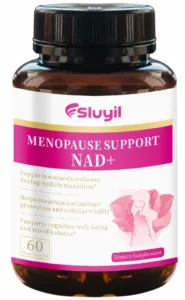
The confirmed amounts below are per two-capsule serving. They are useful here because the combined formula, rather than any single headline ingredient, determines the required fill volume and the suitability of the selected shell.
| Label Ingredient | Amount per Serving | Specification Shown on Label |
| Beta-Nicotinamide Mononucleotide (NMN) | 300 mg | At least 99% |
| Red clover extract (aerial parts) | 200 mg | At least 8% isoflavones |
| Ashwagandha root extract | 100 mg | At least 10% withanolides |
| Sage leaf extract | 100 mg | At least 2.5% rosmarinic acid |
| S-Equol | 10 mg | At least 98% |
| PQQ as disodium salt | 10 mg | At least 99% |
| Astaxanthin | 4 mg | No assay percentage stated in the panel |
The label also lists microcrystalline cellulose and vegetable-source magnesium stearate. These excipients occupy space and influence processing, so the sum of declared actives is not a substitute for measuring the complete blend. The suggested use is two capsules daily with food and water, or as directed by a healthcare provider. Those directions, serving count, and shell statement should remain aligned with the approved product specification and artwork.
This product is useful for a shell-selection discussion because the formula combines multiple botanical and cellular-nutrition ingredients at different amounts. The shell decision therefore sits alongside serving count, total fill volume, powder behavior, and the market’s preference for a plant-based presentation.
The current vegetable shell should not be treated as proof that HPMC is required for every menopause-support formula. A private label version with different ingredient amounts, extracts, excipients, or positioning may produce a different technical and commercial answer. Conversely, switching the current concept to gelatin should not be treated as a simple cost reduction. It would require review of shell source, formula compatibility, appearance, label claims, disintegration, packaging, and stability.
The existing small-batch vegetarian capsule manufacturer guide can help a buyer qualify a supplier. This article answers a different question: which shell should the product specification use? Keeping those decisions separate reduces the risk of selecting a factory before the brand understands what it needs the factory to make.
A Practical Approval Checklist
Before approving the shell, request:
- shell manufacturer, material, grade, size, color, and full composition;
- dietary and religious declarations or certifications relevant to the label;
- compatibility assessment for the complete fill blend;
- pilot-run observations for separation, filling, locking, and rejects;
- disintegration or dissolution method and acceptance criteria;
- proposed bottle, blister, liner, desiccant, and storage conditions;
- stability plan using the commercial shell and packaging; and
- change-control language for substitute shells or suppliers.
If those items are clear, the vegetable vs gelatin capsules choice becomes traceable. If they are missing, the label claim is ahead of the product specification.
Conclusion
Choosing vegetable vs gelatin capsules is a product-development decision with marketing consequences, not a marketing decision with a shell added later. HPMC can support plant-based positioning, lower-moisture systems, and formulas where gelatin crosslinking or brittleness deserves attention. Gelatin remains a practical and familiar choice for compatible formulas and markets that do not require a plant-based shell.
Start with the complete formula, identify the target consumer and claims, compare actual supplier specifications, run the selected shell on the intended equipment, and verify the finished capsule in its commercial packaging. The better shell is the one that protects the formula, runs consistently, supports truthful positioning, and remains available at a workable finished cost.
FAQ
Are Vegetable Capsules Always Made From HPMC?
No. HPMC is common, but other plant- or fermentation-derived shell systems exist. The specification should name the material and grade rather than relying only on “vegetable capsule.”
Are HPMC Capsules Automatically Vegan?
Plant-derived HPMC can support vegan positioning, but the complete shell system, colors, processing aids, and documentation must support the claim. Verify the supplier declaration rather than assuming.
Do Vegetable Capsules Dissolve More Slowly Than Gelatin?
Not necessarily. Standard HPMC and gelatin shells can both be immediate-release systems. Dissolution depends on the specific shell, formulation, test medium, storage, and whether a specialized delayed-release design is used.
When Is Gelatin Crosslinking a Concern?
It deserves review when the fill contains reactive materials, including certain aldehyde-containing ingredients or extracts. The manufacturer should evaluate compatibility and confirm disintegration or dissolution through testing.
Are Gelatin Capsules Cheaper Than HPMC Capsules?
They are often quoted at a lower shell price, but current pricing varies by supplier, size, color, certification, and order volume. Compare the total finished-product cost and formulation risk, not the empty shell alone.
Can a Brand Change From HPMC to Gelatin After Launch?
Yes, but it is a controlled product change. Reassess formula compatibility, label claims, shell source, machine performance, testing, packaging, and stability before using the new shell commercially.
Which Shell Does Menopause Support NAD+ Use?
The current Hekona product uses a vegetable capsule identified as hypromellose in the related product article. A customized version should confirm its own shell specification rather than assuming it will remain identical.