PQQ has started showing up in more products aimed at cellular energy, mitochondrial support and healthy aging. For a supplement buyer, though, choosing PQQ is usually the easy part. The real work starts after that.
How much PQQ should be in a capsule? Should CoQ10 be in the same formula? What if a 10 mg ingredient needs to be blended with 50 mg or 100 mg versions of other ingredients? Then there’s packaging, serving size, MOQ, and will the first order need to be a custom formulation?
A combination of PQQ, CoQ10, Alpha Lipoic Acid and familiar vitamins is one way to handle these points without turning the label into a long list of unrelated ingredients.
The Cellular Vitamin Complex uses that approach. PQQ and CoQ10 give the product its main direction. And, of course, Alpha Lipoic Acid and several vitamins complete the core of the mixture. When finished, the capsule looks like something you can take every day. It’sCoQ10, and most people know what that is, but few people know about PQQ yet.

What Is Different About a PQQ + CoQ10 Cellular Vitamin Complex?
A standard multivitamin often tries to cover a wide range of vitamins and minerals in one product. That is not really what is happening here.
Of most interest here are PQQ and CoQ10. Then there is Alpha Lipoic Acid, and also good amounts of Vitamin C and Vitamin E. The B vitamins in this formula make it look somewhat more like a daily vitamin formula than it otherwise would.
There is a commercial reason for doing it this way.
A product made only with specialty ingredients can take more explanation. Distributors may understand it, but the consumer still has to know why those ingredients belong together. At the other end, a basic vitamin complex is familiar but gives a brand less room to stand apart.
PQQ + CoQ10 falls somewhere in between.
Familiar Vitamins Make the Product Easier to Place
B vitamins are not the headline ingredients here, and they do not need to be.
Their value is that people already recognize them. On a product page or bottle label, that can make the whole formula feel less unfamiliar.
This becomes useful when a brand is selling through several channels. A specialist distributor may focus on PQQ and CoQ10. An e-commerce customer may first notice the vitamins. Both are looking at the same capsule, just from a different angle.
PQQ and CoQ10 Carry the Main Product Idea
PQQ gives the product its more specialized cellular-energy and mitochondrial-support direction.
CoQ10 is easier for many buyers to recognize. It has been used for years across energy, antioxidant and healthy-aging supplement ranges.
That difference in familiarity is actually useful. PQQ makes the formula less ordinary; CoQ10 makes it easier to explain.
What Is Actually Inside the Formula?
There are ten active ingredients in the finished capsule, but they do not all play the same role.
The two ingredients that matter most to the product identity are PQQ Disodium Salt and Coenzyme Q10.
Each capsule contains 10 mg of PQQ Disodium Salt and 50 mg of Coenzyme Q10.
That combination gives the product a clear center. A buyer does not have to explain ten equal “hero ingredients” at the same time, which is something that can make a supplement difficult to position.
The Antioxidant Side of the Formula
Alpha Lipoic Acid is included at 100 mg per capsule. Vitamin C is also 100 mg, while Vitamin E is 15 mg.
They sit behind the PQQ + CoQ10 combination rather than competing with it.
That gives the product room to fit into Cellular Wellness or Antioxidant Support ranges without changing the basic PQQ + CoQ10 story.
B Vitamins Fill Out the Daily-Wellness Side
The B-vitamin levels are much smaller:
| Ingredient | Per Capsule |
| Vitamin B1 | 1.5 mg |
| Vitamin B2 | 1.7 mg |
| Vitamin B3 | 20 mg |
| Vitamin B6 | 2 mg |
| Vitamin B12 | 2.5 mcg |
They are useful supporting ingredients, but they are not what defines the product.
Looking at the full formula makes the hierarchy easier to see:
| Active Ingredient | Per Capsule |
| PQQ Disodium Salt | 10 mg |
| Coenzyme Q10 | 50 mg |
| Alpha Lipoic Acid | 100 mg |
| Vitamin C | 100 mg |
| Vitamin E | 15 mg |
| Vitamin B1 | 1.5 mg |
| Vitamin B2 | 1.7 mg |
| Vitamin B3 | 20 mg |
| Vitamin B6 | 2 mg |
| Vitamin B12 | 2.5 mcg |
Should a Brand Use PQQ Alone or Build a Larger Formula?
Sometimes the simpler product is the better one.
A PQQ-only capsule is easy to read and easy to explain. The customer sees the ingredient, the dosage and the reason for buying it almost immediately. If the brand already sells products to consumers who know PQQ, there may be no need to add anything else.
The Cellular Vitamin Complex serves a different buyer.
Here, CoQ10 and the vitamin base make it easier to connect PQQ with categories that are already familiar in the market. Cellular Energy, Healthy Aging, Antioxidant Support and Daily Wellness are all possible directions, depending on how the brand handles its label and sales material.
There is no need to force every one of those messages onto the front of the bottle. Usually that makes the product harder to understand, not easier.
Price point matters too. So does the rest of the product line. A company that already sells a premium CoQ10 product may see this combination differently from a company launching its first healthy-aging supplement.
One Capsule a Day Is a Small Detail That Affects the Whole Product
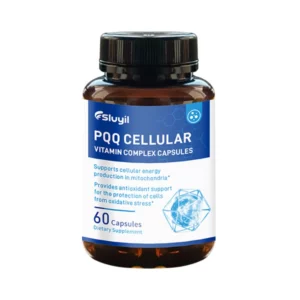
The complete serving fits into one capsule.
With 60 capsules in the bottle, that gives a 60-day supply.
From the buyer’s side, this is convenient because the serving instruction is simple. From the production side, it also has consequences. Bottle size, capsule count, packaging cost and cost per serving all change when the daily dose moves from one capsule to two or three.
It is worth deciding this early. Serving format is much harder to change once the packaging and retail price have already been set.
Where Does the Manufacturing Difficulty Come From?
A ten-ingredient capsule does not automatically mean a difficult production run.
The bigger issue here is the difference in dosage.
PQQ is used at 10 mg. CoQ10 is 50 mg. Alpha Lipoic Acid and Vitamin C are each 100 mg.
Those numbers look simple in a specification sheet. Mixing the powders evenly across a commercial batch is where things become more practical.
A 10 mg Ingredient Has to Stay Evenly Distributed
Powders do not all behave the same way.
Even two fine powders can have very different characteristics such as particle size and shape, and flow and density. If the lower-dose material of PQQ behaves differently from the bulk of the blend then it cannot be assumed that normal mixing will result in an even distribution of this material throughout the blend.
Premixing may be needed. The mixing sequence can matter as well.
Commercial capsule manufacturing therefore goes beyond getting the ingredients into an empty shell. Raw-material identity, blend uniformity, fill weight, microbiological limits, heavy metals and batch traceability can all become control points in the production of a food.
A label may say 10 mg PQQ. The factory still has to make that 10 mg repeatable across the batch.
That is the difference between a formula that exists on paper and one that works in routine production.
Check the Sales Market Before Locking the Formula
Another issue often comes up fairly late in a project: where will the product actually be sold?
That question affects the work much earlier than many buyers expect.
Raw-material specifications, status of ingredients, label copy, claims, capsule-form and quality documents are not necessarily treated equally in different markets.
PQQ is a specialty ingredient, so this point deserves attention before labels are printed and packaging is ordered.
A buyer does not want to finish the formula, approve the artwork and then discover that something has to be changed for the intended market. Checking that point earlier is simply cheaper.
Ready Stock, Private Label or Custom Formulation?
A first PQQ order does not always need to begin with custom development.
For some buyers, testing an existing product is the sensible place to start. Others already have a clear dosage or positioning in mind and need a different formula from day one.
Ready Stock Works for Early Testing
When the finished product is available from stock, trial orders can start from 100 bottles.
That is enough for many early-stage uses: sending samples to distributors, testing an e-commerce listing, preparing for a trade show or getting initial feedback from the market.
There is little benefit in committing to a large custom project if the company still does not know how customers will respond to the category.
A small first order answers that question with less risk.
Private Label Keeps Development Simple
If the existing formula already fits the project, the buyer may only need its own label, brand and packaging.
The ingredient list stays the same.
This route is often faster because there is no need to reopen the whole formulation process. For a brand trying to launch on a timetable, that can matter more than changing a few ingredients just to make the formula different.
Custom Formulation Is Useful When Something Really Needs to Change
A custom project makes more sense when there is a clear reason behind it.
The PQQ dosage may need to move. CoQ10 may need to be higher or lower. The capsule shell, supporting ingredients or daily serving may also need to change.
For suitable capsule projects, commercial custom production typically starts from around 1,000 bottles.
That number is only a starting point.
A specialty raw material may come with its own supplier MOQ. Packaging may have a minimum purchase quantity as well. Once those requirements are added together, the practical order size can end up higher than the number originally discussed for finished bottles.
This is why MOQ is better checked against the actual formula instead of treated as one fixed number for every product.
Manufacturing Support Matters More Once the Product Is Customized
After a custom formula is approved, there is still plenty of work left.
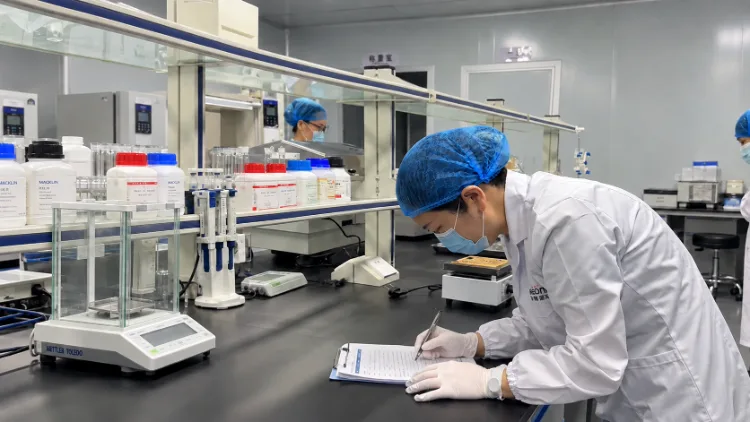
Raw materials have to be sourced. Powders have to be blended. Capsule filling has to run at a stable weight. Finished batches need quality checks, and the packaging has to match the agreed product.
Hekona supports dietary supplement projects from formulation review and capsule manufacturing through packaging and quality-control coordination.
Some brands begin with ready stock, learn what the market responds to, and only then move into a custom version. That route can make more commercial sense than trying to decide every formulation detail before the first bottle has been sold.
Conclusion
PQQ and CoQ10 are the ingredients that give this Cellular Vitamin Complex its main direction.
Alpha Lipoic Acid, Vitamin C and Vitamin E add to that base, while the B vitamins keep a familiar daily-supplement element in the formula. The serving stays simple at one capsule a day.
For a buyer, the next question is less about adding another ingredient and more about deciding how far the product needs to be customized.
Ready stock is useful when the market still needs testing. Private label works when the existing formula already fits. Custom formulation becomes worth the extra work when dosage, capsule format or product positioning actually needs to change.
Whatever route is chosen, the formula still has to run properly in production. That part matters just as much as what ends up printed on the label.
FAQ
What Makes This Different from a Conventional Multivitamin?
A conventional multivitamin usually tries to cover a broad range of vitamins and minerals. This product puts PQQ, CoQ10 and Alpha Lipoic Acid closer to the center, while the vitamins provide a more familiar daily-supplement base.
Why Combine PQQ with CoQ10?
PQQ gives the product a more specialized cellular-energy direction. CoQ10 is already familiar to a much wider group of supplement buyers, so the two ingredients can be easier to position together than PQQ on its own.
Can PQQ Be Combined with B Vitamins?
Yes. In this formula, the B vitamins sit behind the PQQ + CoQ10 combination and provide the more familiar daily-vitamin part of the product.
Can Brands Start with a Ready-Stock Version?
Yes, if the finished product is available from stock. Trial orders can begin from 100 bottles, which is useful when a brand wants to test the market before committing to a larger private-label or custom project.
What Is the MOQ for a Custom PQQ Formula?
For suitable capsule projects, commercial custom production typically starts from around 1,000 bottles. The actual MOQ can change with raw-material availability, supplier minimum purchase quantities, dosage and packaging requirements.