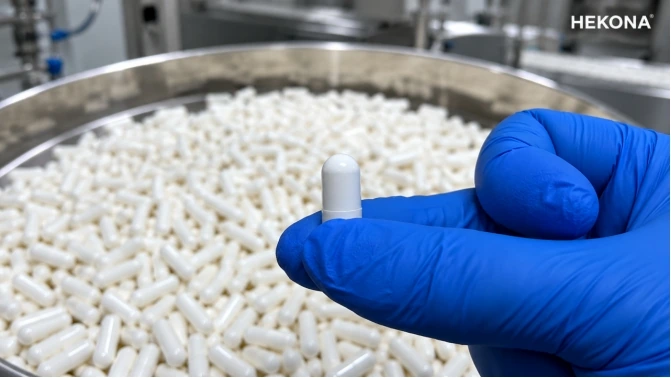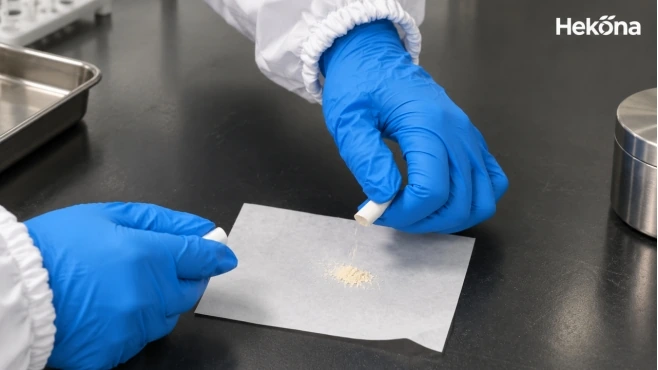

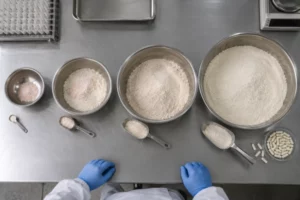
A multi-ingredient botanical capsule may contain kilograms of botanical extracts but only a very small amount of chromium material.
Put those quantities side by side and the difference is obvious.
The botanical material may fill a large liner. The chromium may fit into a small weigh boat.
The difficult part is not putting the chromium number on the formula sheet.
The real question is whether the manufacturer can account for that low-dose material from weighing through premixing, main blending, transfer, hopper residence, and the full capsule-filling run.
This is why a low-dose ingredient project cannot be understood from the finished-product COA alone.
The commercial raw material, batch calculation, weighing route, premix method, transfer record, sampling points, and filling data all need to make sense as one manufacturing path. Low-Dose Ingredients in Capsule…
Consistent Capsule Weight Does Not Prove Consistent Chromium Content
This is one of the easiest points to misunderstand.
Suppose two capsules both have a total fill weight close to 500 mg.
That tells us the total powder weight is similar.
It does not prove that the chromium content inside those two capsules is the same.
The filling machine controls total powder entering the shell. It does not know where the low-dose chromium sits inside that powder.
When reviewing a problem, fill weight and chromium concentration therefore need to be treated as different results.
| What You See | Where to Look First |
| Fill weights are stable, but chromium results vary | Premix record, blending history, segregation risk, sampling points |
| Chromium concentration is relatively stable, but fill weights vary | Powder flow, hopper feed, filler setup |
| Both results move | Trace the process from main blending through transfer and filling |
These patterns do not prove the cause by themselves.
Their value is that they stop every uneven result from being blamed on the capsule filler. Low-Dose Ingredients in Capsule…
1. “Chromium” Is Not a Complete Raw Material Specification
A purchasing document that says only:
Chromium
is not enough for commercial production.
The project needs the actual commercial grade.
Questions to close include:
- Which chromium compound is being used?
- What is the active concentration?
- Is the reported assay elemental chromium or compound weight?
- Is the material diluted onto a carrier?
- Which supplier lot will be dispensed?
- Which method and unit appear on the supplier COA?
These questions look basic, but this is where many calculation errors begin. Low-Dose Ingredients in Capsule…
For example, the Supplement Facts target may be stated as elemental chromium while the supplier sells a diluted chromium premix.
The batch sheet cannot simply copy the number from the label.
The actual weigh-up has to come from the commercial material concentration, target amount per serving, and planned production quantity.
Keep the calculation with the approved formula.
The worksheet should also show the formula version, calculation basis, reviewer, and rounding rule.
A practical check is simple:
Can another qualified reviewer reach the same batch-sheet amount without calling the formulator?
If not, the record is not finished.
Small Weights Also Need the Right Weighing Route
A very precise calculation does not mean the production floor can reliably weigh that quantity.
The next question is:
Which balance will be used, and is the target weight inside a suitable working range?
If the amount is too small for reliable direct dispensing, the answer is not to add another decimal place to the batch record.
A different route may be needed.
That can mean using a lower-strength commercial premix or making an earlier controlled dilution.
One point from the original draft is worth keeping:
More decimal places do not make a balance more capable.
HEKONA’s raw material sourcing and supplier management helps establish which approved supplier, specification, and lot entered the factory.
The formula and manufacturing documents still have to define how much of that material belongs in the batch. Low-Dose Ingredients in Capsule…
2. Approve the Commercial Grade Before Locking the Process
Development teams often start with whatever sample is already available.
That is fine for an early trial.
It is risky to treat that sample as the final commercial instruction.
The production material may have a different:
- carrier;
- concentration;
- particle profile;
- bulk density.
Any of these can change both the amount weighed and the way the powder behaves.
So:
“Same chromium” does not necessarily mean “same manufacturing material.”
Before the process is locked, review the approved raw material specification together with the supplier COA. Low-Dose Ingredients in Capsule…
Check the chemical form, active fraction, assay basis, carrier, lot, method, reporting unit, and shelf-life or retest information.
For a diluted commercial ingredient, another question matters:
What makes up the rest of the material?
That answer belongs in the project file, not only in an email or chat thread.
Watch the Powder, Not Only the COA
A COA can tell you the reported assay result.
It cannot tell an operator whether the powder will stay on a liner, cling to a scoop, or behave badly during transfer.
It also does not show whether:
- fine material dusts during transfer;
- a dense fraction moves downward under vibration;
- an electrostatic premix sticks to plastic surfaces;
- poor-flowing powder bridges above the feed point.
Those observations come from development and production work.
HEKONA’s laboratory testing capabilities can support selected physical and analytical checks, with qualified external laboratories used where needed depending on the product and method.
If particle size, density, or flow is important to the formula, the project still needs a defined measurement, method, and acceptance basis.
An equipment list alone does not create a product control plan.
3. “Use Geometric Dilution” Is Not Yet a Premix Instruction
A low-dose ingredient should not simply be poured into a large quantity of botanical powder with the assumption that more mixing time will solve the problem.
Geometric dilution is one common approach for low-dose ingredients.
The basic idea is to first create a smaller, manageable premix, then increase the blend in controlled stages.
But the phrase “use geometric dilution” is not enough for production.
The manufacturing instruction still needs to define the important points:
- how much chromium material starts the premix;
- how much compatible material is added at each stage;
- the addition order;
- the vessel and tools;
- how complete transfer is confirmed.
The most concentrated stage deserves particular attention.
Material can remain in liner seams, on the underside of a screen, or on tools that are about to be cleared away. Low-Dose Ingredients in Capsule…
For several kilograms of botanical material, that loss may look small.
For a low-dose ingredient, it can matter much more.
“Transferred completely” should therefore describe an observed and recorded action, not an assumption.
Longer Mixing Does Not Automatically Mean Better Uniformity
“Mix it longer” is not a universal fix.
Extra mixing cannot correct a formula calculation error.
It cannot recover chromium material that has already been lost on a liner, screen, or tool.
And in some blends, continued movement can give materials with different densities or particle sizes more opportunity to segregate again.
The manufacturing route also continues after the blender stops.
The material still moves through:
discharge → intermediate container → transfer → hopper residence → capsule filling
Uniformity control needs to follow that route rather than stop at the mixer. Low-Dose Ingredients in Capsule…
4. One Passing Mixer Sample Does Not Represent the Whole Run
“Batch sample” is not a complete description.
A useful sample record should say where and when the material was collected.
A surface sample from the blender and a discharge sample answer different questions.
The same applies after encapsulation.
Early, middle, and late capsules may need to remain separate long enough to show whether a run trend exists.
Combining them too early can hide that information.
HEKONA’s capsule manufacturing process covers material preparation, blending, filling, and in-process checks.
For a low-dose ingredient project, the more useful questions are:
- What can change after premixing?
- What is checked before discharge?
- Can transfer create another segregation risk?
- Are early and late capsules represented?
A passing mixer sample answers the mixer question.
It does not automatically prove that every later step behaved the same way. Low-Dose Ingredients in Capsule…
5. Scale-Up Needs a Fresh Observation
A small development jar does not reproduce a commercial blender.
At scale, the project changes in several ways:
- batch load;
- equipment geometry;
- discharge pattern;
- transfer distance;
- residence time at the filler.
During an engineering batch or first commercial run, useful observations go beyond a final “Pass.”
Record where powder collected.
Check whether transfer was complete.
Compare early, middle, and late capsules where appropriate.
Look at whether a change in fill weight happened at the same time as a change in chromium result.
These observations are often more useful than copying a bench mixing time directly into the commercial batch record. Low-Dose Ingredients in Capsule…
6. U.S. Market: Facility GMP Certification and Product-Specific Control Are Different Things
For U.S. dietary supplement projects, 21 CFR Part 111 provides an important GMP framework for component, in-process, and finished-product specifications, together with appropriate sampling, testing, and verification.
It does not prescribe one universal mixing or sampling map for every low-dose formula.
The manufacturer still needs a suitable plan based on the formula, material characteristics, equipment, and process. Low-Dose Ingredients in Capsule…
HEKONA is certified to:
NSF/ANSI 455-2 – Good Manufacturing Practices for Dietary Supplements
The certified scope covers dietary supplement manufacturing activities across capsules, powders, tablets, and beverages, together with applicable GMP controls.
That facility-level certification is important, but it does not replace product-specific control.
For a low-dose chromium formula, the actual commercial project still needs its own:
- calculation;
- weighing route;
- premix procedure;
- sampling plan;
- finished-product verification.
A GMP certificate and a product-specific manufacturing record solve different problems.
7. Apply the Controls to the Formula Being Ordered
HEKONA’s Glucose Balance Complex with Cinnamon, Bitter Melon & Chromium is a useful discussion example.
The formula combines higher-load standardized botanical ingredients with a much lower-dose chromium component.
That makes it useful for explaining why ingredients listed on the same formula sheet may still require different manufacturing controls.
This example should not be copied as a batch recipe for another project.
A new order may change the chromium grade, target amount, serving size, botanical ingredients, or commercial batch size.
Before production, the brand and manufacturer should connect the following records:
- approved raw material specifications and relevant supplier COAs;
- calculation from the label target to the actual commercial chromium material;
- premix and main-blend requirements;
- sampling locations or collection times;
- transfer and filling controls;
- finished-product specifications;
- agreed batch-release documents.
HEKONA’s finished-product assurance provides the broader factory-level quality framework.
Each commercial order still needs those general controls narrowed down to:
What will be done for this product, how it will be judged, and what will release the batch.
Conclusion
A low-dose chromium project file should read like a route map.
It starts with the commercial raw material supplied to the factory and ends with the filled capsule.
At each important step, the record should leave enough evidence to explain the final result:
- material concentration;
- formula calculation;
- weighing route;
- premix control;
- transfer record;
- sampling purpose;
- finished-product verification.
That is what makes a blend-uniformity or chromium result meaningful.
If the process records are missing and only a final “Pass” result remains, that number tells the brand much less.
The key to low-dose ingredient control is not:
“Mix it for a few more minutes.”
It is:
Connect the raw material specification, weighing, premixing, transfer, sampling, and filling into one controlled manufacturing route.
FAQ
Does consistent capsule weight prove even chromium distribution?
No.
Capsule weight measures the total powder inside the shell.
It does not directly measure the chromium content.
Fill-weight consistency and low-dose ingredient distribution are different questions. Low-Dose Ingredients in Capsule…
Is geometric dilution mandatory for every low-dose ingredient?
No.
The premix approach should be selected from the actual commercial material, including its concentration, carrier, powder behavior, batch size, and manufacturing equipment.
Geometric dilution is one option, not the only possible method.
Will longer blending fix poor low-dose uniformity?
Not necessarily.
Extra mixing cannot correct a calculation error or recover material already lost during handling.
For some blends, prolonged movement may also increase the opportunity for segregation.
Why is one mixer sample not always enough?
A mixer sample represents a specific place and time.
After blending, the powder still passes through discharge, transfer, hopper residence, and capsule filling.
If segregation can occur later in the process, one mixer sample may not show the whole picture.
What should be approved before the first commercial batch?
At minimum, the project should have an approved formula, commercial raw material specifications, batch calculation, premix requirements, sampling plan, finished-product specifications, and agreed batch-release documents.
These should be settled before commercial production begins. Low-Dose Ingredients in Capsule…