
A 600 mg NMN supplement can be a practical commercial formula, but the dosage affects much more than the number printed on the Supplement Facts panel. It influences capsule size, daily capsule count, powder volume, raw-material cost, bottle configuration and even the markets where the finished product may be sold.
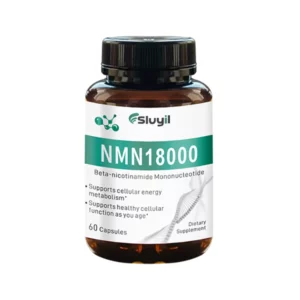
That is why dosage should be decided before the rest of the product is built around it. In the formula discussed here, each serving provides 600 mg of β-Nicotinamide Mononucleotide (β-NMN), together with 40 mg of Pterostilbene and 30 mg of Magnesium in a two-capsule serving.
For a supplement brand, the useful question is not simply whether 600 mg sounds competitive. The real question is whether that dose can be turned into a stable, practical capsule product with a clear ingredient hierarchy, workable manufacturing process and suitable commercial positioning.
Is 600 mg NMN a Practical Dose for Supplement Formulation?
A 600 mg daily NMN dose has been used in human research, which gives product developers a useful reference point when evaluating a commercial formula.
One randomized, multicenter, double-blind, placebo-controlled trial included 80 healthy adults aged 40–65. Participants received 300 mg, 600 mg or 900 mg of NMN per day, or placebo, for 60 days. Blood NAD concentrations increased significantly in the NMN groups, with the 600 mg and 900 mg groups showing the highest levels. NMN was also reported as well tolerated at the doses studied.
That finding should not be interpreted as proof that 600 mg is the universally “best” dose. Consumer profile, target market, capsule format, ingredient status and product positioning still need to be considered.
For product development purposes, however, 600 mg gives a brand something useful to work with: a human-studied dose that can form the starting point for a commercial NMN formula.
What Does a 600 mg NMN Formula Look Like?
The example formula keeps NMN as the dominant active rather than adding a long list of ingredients simply to make the label look more complex.
| Active Ingredient | Per Serving |
| β-Nicotinamide Mononucleotide (β-NMN) | 600 mg |
| Pterostilbene | 40 mg |
| Magnesium (as Magnesium Glycinate) | 30 mg |
Serving Size: 2 Capsules
Capsules Per Bottle: 60
Servings Per Bottle: 30
This structure gives the formula a clear hierarchy. NMN provides the main dosage story, while Pterostilbene and Magnesium support the positioning without competing with the core ingredient.
NMN Remains the Main Active
At 600 mg per serving, NMN clearly defines the product. This matters from both formulation and marketing perspectives.
If too many secondary ingredients are added at prominent doses, the product can become harder to explain. A focused formula is usually easier for a distributor or consumer to understand: the buyer immediately knows what the main ingredient is and why the product exists.
The same point matters during production. A high proportion of NMN means its powder characteristics will have a major influence on capsule capacity, blend flow and fill-weight consistency.
Brands that want to review an existing NMN format can also compare it with Hekona’s NMN supplement formulation before deciding whether an established product or a custom formula is the better route.
Why Add Pterostilbene and Magnesium?
Pterostilbene plays a secondary role in this formula. At 40 mg per serving, it adds a polyphenol and Healthy Aging angle without taking attention away from the 600 mg NMN dose.
Commercial NMN products combining NMN with Pterostilbene already exist, but that does not mean Pterostilbene should be presented as making NMN more effective or as being clinically proven to improve NMN performance.
A more defensible product story is simply that Pterostilbene provides a complementary Healthy Aging component.
Magnesium serves a different purpose. At 30 mg per serving, it adds a familiar nutritional component while remaining clearly secondary to NMN.
The formulation therefore stays easy to read:
NMN is the core active. Pterostilbene provides differentiation. Magnesium provides supporting nutrition.
How Does a 600 mg NMN Dose Affect Capsule Design?
A high NMN dose quickly turns formulation theory into a physical manufacturing question. Before excipients and the other actives are fully considered, the serving already needs to carry 600 mg of NMN.
A capsule has a fixed amount of usable internal space, so a brand cannot simply request “600 mg NMN in one capsule” and assume the product can be produced that way.
Capsule Size and Daily Serving Count
The amount that fits into a capsule depends on more than ingredient weight. Powder bulk density, particle characteristics, flowability and required excipients all affect the real fill volume.
That creates a practical choice. A brand can sometimes use a larger capsule, increase the number of capsules per serving, or adjust the overall formula.
For this product, two capsules per serving provide more room for 600 mg NMN plus Pterostilbene, Magnesium and the excipients required for commercial filling.
Swallowability also matters. A technically possible capsule is not always the best consumer format if it becomes unnecessarily large.
Powder Properties and Fill Consistency
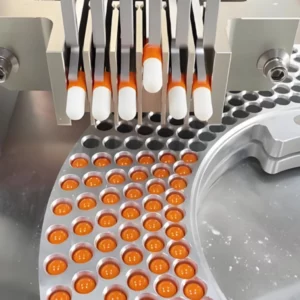
High-active-load formulas still need to run reliably on commercial capsule equipment.
Before encapsulation, a manufacturer may need to evaluate:
- particle-size distribution
- powder bulk density
- flowability
- moisture characteristics
- blend behavior
- capsule capacity
- fill-weight consistency
- repeat-batch performance
The ingredient ratio adds another consideration. NMN is present at a much higher level than Pterostilbene and Magnesium, so the blend has to maintain adequate distribution of the lower-level ingredients while still flowing consistently during capsule filling.
This is where commercial formulation work becomes different from simply writing three ingredients and their target weights on a formula sheet.
Cost, Bottle Count and Retail Positioning
Changing the NMN dosage can also change the economics of the entire product.
A higher NMN dose requires more raw material per batch. It may require more capsules per serving, which changes the number of capsules needed for a 30- or 60-day supply. That can affect bottle size, filling quantity, packaging components and freight efficiency.
The finished cost then influences retail positioning.
For a B2B buyer, NMN dosage is therefore a nutritional, manufacturing and commercial decision at the same time. A dose should make sense on the label, on the production line and in the final selling price.
What Should Be Checked Before Commercial NMN Production?
A formula that looks straightforward on paper still needs technical and regulatory review before it becomes a commercial product.
Manufacturing Feasibility Comes Before Scale-Up
For NMN18000, the central production question is whether a high-active-load formula can be filled consistently from batch to batch.
A manufacturer needs to check whether the powder can blend properly, whether the lower-level ingredients remain adequately distributed, whether the target fill weight fits the selected capsule and whether the same process can be repeated in commercial production.
For brands working with high-load or multi-ingredient capsule formulas, Hekona’s capsule manufacturing process can cover formulation review, capsule filling and scale-up rather than treating encapsulation as an isolated final step.
This is also why early formulation work matters. A change in ingredient source, particle size or powder behavior can sometimes affect production even when the Supplement Facts panel remains unchanged.
Target-Market Compliance Should Be Checked Early
Manufacturing feasibility does not automatically mean a formula is suitable for every country.
NMN is a clear example because its regulatory treatment differs by market and continues to develop. The European Commission’s Novel Food consultation database identifies NMN of 95–99% purity as a Novel Food. A separate 2025 EU Novel Food application for chemically produced β-NMN proposed use in adult food supplements at up to 500 mg/day, but an application does not mean that every NMN product has received general authorization.
That distinction matters for a formula providing 600 mg per serving.
Before production, the brand should confirm the intended country of sale, ingredient regulatory status, permitted dosage, claims, labeling requirements and required product documentation.
The target market should shape the final formula, rather than developing a product first and checking compliance afterward.
For custom projects, formulation and regulatory questions can also be reviewed earlier in the development process through Hekona’s R&D expertise.
Ready Stock, Private Label or Custom NMN?
Not every NMN brand needs to begin with a fully custom formula. The right route depends on how much of the product already fits the intended market and how much the brand actually needs to change.
Start with Ready Stock When Market Testing Comes First
If an established NMN formula is available from stock, a brand can start with trial orders from 100 bottles.
This gives the buyer a lower-risk way to answer practical questions before committing to a larger project:
- Is the price accepted?
- Does the target audience understand the NMN positioning?
- Which packaging direction works better?
- Are distributors interested?
- Does the product fit the intended sales channel?
For a new brand, this type of small test can be more useful than customizing every detail before there is any market feedback.
Use Private Label When the Existing Formula Already Fits
If the formula itself is suitable, private labeling allows the underlying product to remain unchanged while the buyer develops its own brand, label and packaging.
This route can reduce development time because the basic formulation work has already been completed.
Brands can use Hekona as a manufacturing reference when comparing whether an existing NMN formula can be taken to market directly or whether changes are genuinely needed.
Choose Custom Formulation When There Is a Clear Reason to Change
Customization becomes more useful when the brand needs to change the NMN dosage, Pterostilbene level, supporting ingredients, capsule size, daily capsule count, bottle quantity or market positioning.
For suitable capsule projects, commercial custom production typically starts from around 1,000 bottles.
The final MOQ still depends on formula feasibility, raw-material availability, supplier MOQ, dosage and packaging. For specialty ingredients, raw-material purchasing requirements can sometimes become the main factor that determines the finished-product MOQ.
The main point is simple: customization should solve a real product or market requirement rather than being added only for the sake of having a different formula.
Conclusion
A 600 mg NMN supplement should be designed around the dose rather than treating the dose as the last number added to the label.
In this example, 600 mg β-NMN remains the core active, while 40 mg Pterostilbene provides differentiation and 30 mg Magnesium adds supporting nutrition. The two-capsule serving gives the formula more practical filling space and avoids forcing a high active load into an unsuitable format.
For a supplement brand, the development path runs from dose selection to capsule capacity, powder behavior, manufacturing consistency, cost, packaging and target-market requirements.
Ready stock is useful when the priority is testing demand. Private label works when an established formula already fits the market. Custom formulation makes sense when the dose, format or positioning genuinely needs to change.
A commercially useful NMN formula is not the one with the longest ingredient list. It is the one that can balance dosage, product positioning, manufacturing feasibility and target-market requirements without making the finished product unnecessarily complicated.
FAQ
Is 600 mg NMN a Human-Studied Dose?
Yes. A 60-day randomized controlled trial involving 80 healthy adults compared 300, 600 and 900 mg/day NMN with placebo. The research provides a useful dosage reference, but it does not establish 600 mg as the universally optimal dose for every consumer or product.
Why Use Two Capsules for 600 mg NMN?
A 600 mg NMN formula also has to accommodate Pterostilbene, Magnesium and required excipients. Powder density, flowability, capsule capacity and swallowability all influence how much material can realistically fit into one capsule, so a two-capsule serving can provide a more practical format.
Why Add Pterostilbene to NMN?
Pterostilbene provides a secondary polyphenol and Healthy Aging angle while allowing NMN to remain the main active. It should be treated as a complementary formulation component rather than used to imply that it has been proven to make NMN more effective.
What Does NMN18000 Mean?
NMN18000 refers to the total amount of NMN in the bottle: 600 mg NMN per serving multiplied by 30 servings gives 18,000 mg of NMN per bottle.
Can a Brand Start with 100 Bottles?
Yes, when the established finished product is available from stock. A 100-bottle trial order can be used to test market response before the brand moves into a larger private-label or custom project.
What Is the MOQ for a Custom NMN Formula?
For suitable capsule projects, commercial customization typically starts from around 1,000 bottles. Final MOQ depends on raw-material availability, supplier MOQ, dosage, formula feasibility and packaging requirements.