
Menopause Support NAD+ Capsules are designed for women’s wellness during midlife transition by combining NAD+ related ingredients with carefully selected botanical extracts. These formulas commonly integrate ingredients such as NMN, red clover extract, ashwagandha, sage leaf extract, S-equol, and other functional ingredients that are selected for women’s wellness formulations targeting areas such as antioxidant protection, cellular vitality, cognitive well-being, and mood balance.
For brands developing this type of women’s wellness supplement, the key challenge is not only selecting suitable ingredients but also ensuring formula consistency, botanical standardization, and reliable manufacturing processes from sampling to commercial production.
Developing menopause support NAD+ capsules requires balancing ingredient selection, dosage design, and manufacturing feasibility. Some brands may begin with an existing formula for market testing, while others may require customization based on specific women’s wellness positioning, ingredient preferences, or regional requirements.
Why Do Menopause Support NAD+ Capsules Require Careful Formula Design?
During midlife transition, women’s wellness formulas often combine multiple ingredient categories rather than relying on a single active compound. This makes formula balance, ingredient compatibility, and manufacturing consistency especially important. Just because there are a lot of ingredients doesn’t mean it is necessarily complex. Typically problems arise because of the differing dosages, densities, extract requirements, flow characteristics, and storage needs of the individual raw materials, which all need to be mixed together as one uniform blend. This is where an apparently simple capsule project starts to reveal whether the factory has real formulation and process control.
Mixed-Dose Formula Complexity
A typical Menopause Support NAD+ Capsules formula combines multiple active ingredients with different dosage levels and functional roles. For example, the current formula contains 300 mg Beta-Nicotinamide Mononucleotide (NMN, ≥99%), 200 mg red clover extract, 100 mg Ashwagandha root extract, 100 mg sage leaf extract, 10 mg S-Equol, 10 mg PQQ as disodium salt, and 4 mg astaxanthin.
A blend of a 300 mg and a 4 mg active ingredient needs a lot more attention than a simple capsule with one single active ingredient. The small amount of active ingredient in a blend needs to be well mixed and the larger amount of active ingredient in the blend needs to have the right flow and filling characteristics.
What Ingredients Are Commonly Used in Menopause Support NAD+ Capsules?
NMN for Cellular Energy Support
NMN is commonly included in NAD+ related supplement formulas because it serves as a precursor involved in NAD+ metabolism. In menopause support formulas, NMN is often combined with botanical extracts to create a multi-ingredient approach instead of focusing on a single compound. The formulation goal is usually to balance NAD+ related ingredients with other women’s wellness ingredients within one daily supplement.
Red Clover Extract for Women’s Wellness
Red clover extract is frequently selected in women’s wellness formulations due to its isoflavone content. For commercial production, standardized extract specifications are important because they influence formula consistency and finished product quality.
Ashwagandha and Sage Extract in Midlife Wellness Formulas
Botanical ingredients such as ashwagandha and sage are often incorporated into midlife wellness formulas. Standardization markers, including withanolides and rosmarinic acid levels, help brands maintain consistent ingredient quality between batches.
Ingredient Compatibility Risks
A complex formula should go through a compatibility review before it reaches the filling line. Bulk density, particle size, hygroscopicity, extract concentration, excipient requirements, and storage conditions all matter. Even when ingredients appear compatible on a label, their physical behavior during mixing may be quite different.
This point is easy to miss during early sourcing discussions because ingredient names attract more attention than powder behavior. On the factory floor, however, flowability and moisture can be just as important as the marketing concept.
Sample-to-Production Consistency
The overseas buyer’s test of the first sample only will prove that one sample was made. The really important test is whether the same raw-material specification, serving size, capsule, fill weight and documents can be made to work for the first production batch and for subsequent reorders.
That is why stock evaluation and custom development should be treated separately. A smaller stock trial lets you inspect an existing finished product. A 500-bottle custom sample order covers a different task because sourcing, formulation review, trial blending, filling, testing, and documentation must all be built around your specification.
What Should a Capsule Supplement Manufacturer Verify Before Production?
Even before production starts, the supplier must be able to describe the materials to be used, how they are checked for suitability and how the end formulation is anchored to these specifications. Especially for smaller foreign companies, one wrong batch can cost them the entire launch budget.
Raw Material Qualification
A proper sourcing system begins with supplier qualification and incoming inspection. Hekona’s raw material sourcing process covers vitamins, botanical extracts, minerals, probiotics, and other supplement materials through a broad supplier network. Incoming materials can be assessed for identity, potency, purity, heavy metals, and microbiological limits before they enter production.
The better purchasing question is therefore not simply, “Can you source NMN?” It is whether the approved purity, botanical standardization, raw-material form, and COA can remain consistent once the project moves beyond samples.
Standardized Botanical Specifications
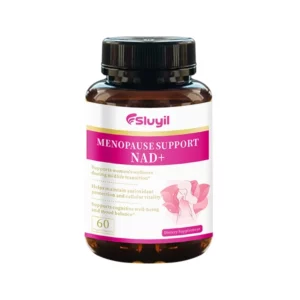
The Menopause Support NAD+ Capsules demonstrate how a women’s wellness formula combines NAD+ related ingredients with standardized botanical extracts. The formula design requires attention to ingredient identity, extract potency, dosage accuracy, and blend uniformity throughout manufacturing.
For B2B sourcing, “100 mg Ashwagandha” and “100 mg of a standardized Ashwagandha extract” are not interchangeable specifications. The difference affects raw-material cost, repeat-order consistency, label accuracy, and what the finished product actually represents.
Formula Compatibility Review
A pre-production review should also check capsule size, expected fill volume, flow aids, low-dose premixing needs, moisture exposure, and the intended serving format. If a formula needs process adjustment, it is far better to identify that before scale-up.
A careful review may also catch label issues early. The current product label, for example, specifies use of two capsules daily with food and water and includes warnings for children, pregnant or nursing women, medication use, and medical conditions. Manufacturing and label review should move together rather than as separate last-minute tasks.
How Does the Menopause Support NAD+ Formula Translate into Manufacturing Requirements?
This formula is positioned around women’s wellness during midlife transition, with a focus on supporting antioxidant protection, cellular vitality, cognitive well-being, and mood balance according to the product label. Those are the boundaries established by the current label. Manufacturing decisions should support that finished specification without turning the formula into broader medical or disease-related claims.
Mixed-Ingredient Serving Design
The product contains 60 veggie capsules, with two capsules per serving and 30 servings per container. Its other ingredients are microcrystalline cellulose, vegetable-source magnesium stearate, and hypromellose as the vegetable capsule.
This serving structure has practical commercial consequences. Two capsules per day determine the monthly consumption cycle, fill-volume target, bottle count, packaging requirement, and landed cost per consumer month. A formula may be technically fillable yet still become awkward commercially if capsule size or daily count moves too far from the intended positioning.
Manufacturing Checkpoints
Hekona’s capsule manufacturing system covers powder and granule filling, multiple capsule shell options, in-line checks, and batch traceability. Its previous hard-capsule controls include a mixing uniformity target of CV ≤5% and filling accuracy of RSD ≤2%.
For a capsule supplement manufacturer, these figures are more useful than a general statement such as “high quality.” They give buyers measurable points to discuss during qualification and later compare with batch records.
Product and Process Comparison
| Buyer Checkpoint | Current Product or Production Reference | Why It Matters |
| Serving size | 2 capsules | Affects fill design and monthly consumption |
| Capsules per bottle | 60 veggie capsules | Provides 30 servings |
| Highest listed active | NMN, 300 mg | Accounts for a large share of fill volume |
| Lowest listed active | Astaxanthin, 4 mg | Makes blend distribution more demanding |
| Mixing target | CV ≤5% | Gives a measurable blend-uniformity reference |
| Filling target | RSD ≤2% | Gives a measurable fill-weight reference |
Which Production Controls Should Buyers Audit?
Factory audits do not need to become chemistry lessons. The purpose is to confirm that the supplier has defined controls at the points where a complex capsule is most likely to drift. For small and medium-sized importers, this also helps distinguish a direct manufacturing operation from a trading intermediary that cannot provide production-level records.
Blend Uniformity Control
Low-dose ingredients may need geometric dilution or stepwise premixing before entering the main batch. Mixer type also matters when raw materials have substantial differences in density or particle size.
The manufacturing system uses V-type, three-dimensional, and other mixers, with uniformity checks incorporated into the production process. This becomes especially relevant for formulas where a few milligrams of one active must remain evenly distributed beside ingredients measured in hundreds of milligrams.
Filling and In-Line Inspection
Capsule filling speed alone says little about quality. A more useful production review looks at weight checks, defective-capsule rejection, metal detection, environmental controls, and recorded batch data.
The broader manufacturing capabilities include automatic capsule filling equipment, in-line weighing, and automatic rejection. These controls help connect laboratory formulation work with repeatable commercial production rather than leaving consistency to final inspection.
Batch Documentation
Documentation should describe the actual batch shipped, not merely the factory in general. A useful review package can include the finished-product COA, ingredient specifications, batch identification, microbiological results, and relevant production records.
For smaller importers, this paperwork is not administrative decoration. If a later batch differs from the approved product, the documents provide the trail needed to find where the change occurred.
How Can Brands Develop Menopause Support NAD+ Capsules with Hekona?
After understanding the formula characteristics of menopause support NAD+ capsules, brands also need to evaluate whether a manufacturer can maintain ingredient consistency, production accuracy, and documentation throughout scale-up. A large factory is not automatically the right factory for a smaller brand. The more relevant question is whether production scale is paired with accessible sampling, direct technical communication, batch records, and a realistic route from initial testing to repeat orders.
Integrated Manufacturing Resources
Hekona operates a 120,000-square-foot production facility covering formulation development, sourcing, capsule production, testing, packaging, and traceability. Its R&D organization has more than 30 members, while capsule production capacity reaches approximately 2 billion capsules annually.
The facility works within FDA registration, GMP, ISO 22000, and HACCP systems. Its R&D team also supports formulation development, material selection, process adaptation, and scale-up work for complex supplement projects.
Sluyil Stock Formula Route
Sluyil is a brand under Hekona. It provides access to more than 100 established stock formulas, giving smaller overseas brands another way to assess an existing product before funding a fully customized specification.
Where an appropriate stock item is available, approximately 100–300 bottles may be discussed for product evaluation, document review, distributor feedback, or early channel testing. This route is most useful when the existing formula already comes close to the intended market position.
If no stock option fits and the formula has to be changed around ingredient levels, serving size, capsule shell, or another key specification, the project moves into custom development with a 500-bottle sample MOQ. The higher quantity reflects additional technical work, so it should be judged against what is being developed, not against the smaller stock-testing route.
Overseas Brand Focus
The current service direction centers on overseas brand owners rather than domestic trading companies. That focus is relevant to small and medium-sized importers that frequently worry about receiving products that differ from approved samples, dealing with an intermediary instead of the actual factory, or finding that basic quality records are unavailable after payment.
For this type of buyer, direct access to the manufacturing team can matter as much as unit price. A slightly cheaper quote becomes expensive very quickly if the supplier cannot explain why a batch changed.
Conclusion
Choosing well means treating manufacturing evidence as part of the formula itself. For menopause support NAD+ capsules, successful product development depends on more than ingredient selection. Brands need consistent raw materials, standardized botanical extracts, reliable blending processes, and a manufacturing partner that can support the transition from formula concept to commercial production.
FAQ
Q1: What Should a Small Brand Check Before Choosing a Capsule Manufacturer?
A: Check raw-material specifications, blending controls, fill-weight consistency, batch traceability, testing documents, capsule shell options, and whether the supplier can reproduce the approved sample during commercial production.
Q2: Can an Existing NAD+ Capsule Be Tested Before a Larger Order?
A: Yes. When a suitable stock formula is available, approximately 100–300 bottles may be discussed for initial evaluation. This quantity can support product inspection, COA review, packaging assessment, distributor feedback, and limited early market testing before larger production is considered.
Q3: What Happens If the Required Formula Is Not in Stock?
A: A new formula requires material sourcing, compatibility assessment, trial blending, capsule filling, testing, and documentation. For this route, custom sampling begins at a 500-bottle MOQ because the project involves development work rather than evaluation of an existing finished product.
Q4: Why Does a Multi-Ingredient NAD+ Formula Need Tighter Mixing Control?
A: Ingredient amounts may range from hundreds of milligrams to only a few milligrams per serving. Differences in dosage, density, particle size, and flow behavior can make even distribution harder, so validated premixing and controlled blending become particularly important.
Q5: What Documents Should a Capsule Supplement Manufacturer Provide for Review?
A: Useful documents include a finished-product COA, ingredient specifications, batch identification, relevant microbiological or contaminant results, and production records that connect the approved formula with the actual manufacturing batch. These documents are especially valuable when comparing samples with later commercial orders.
Q6: What Are Menopause Support NAD+ Capsules Designed For?
A: Menopause Support NAD+ Capsules are designed for women’s wellness during midlife transition. These formulas typically combine NAD+ related ingredients with botanical extracts to support areas such as antioxidant protection, cellular vitality, cognitive well-being, and mood balance.
Q7: What Ingredients Are Included in Menopause Support NAD+ Capsules?
A: Depending on the formula design, menopause support NAD+ capsules may include NMN, red clover extract, ashwagandha, sage leaf extract, S-equol, PQQ, and other functional ingredients.