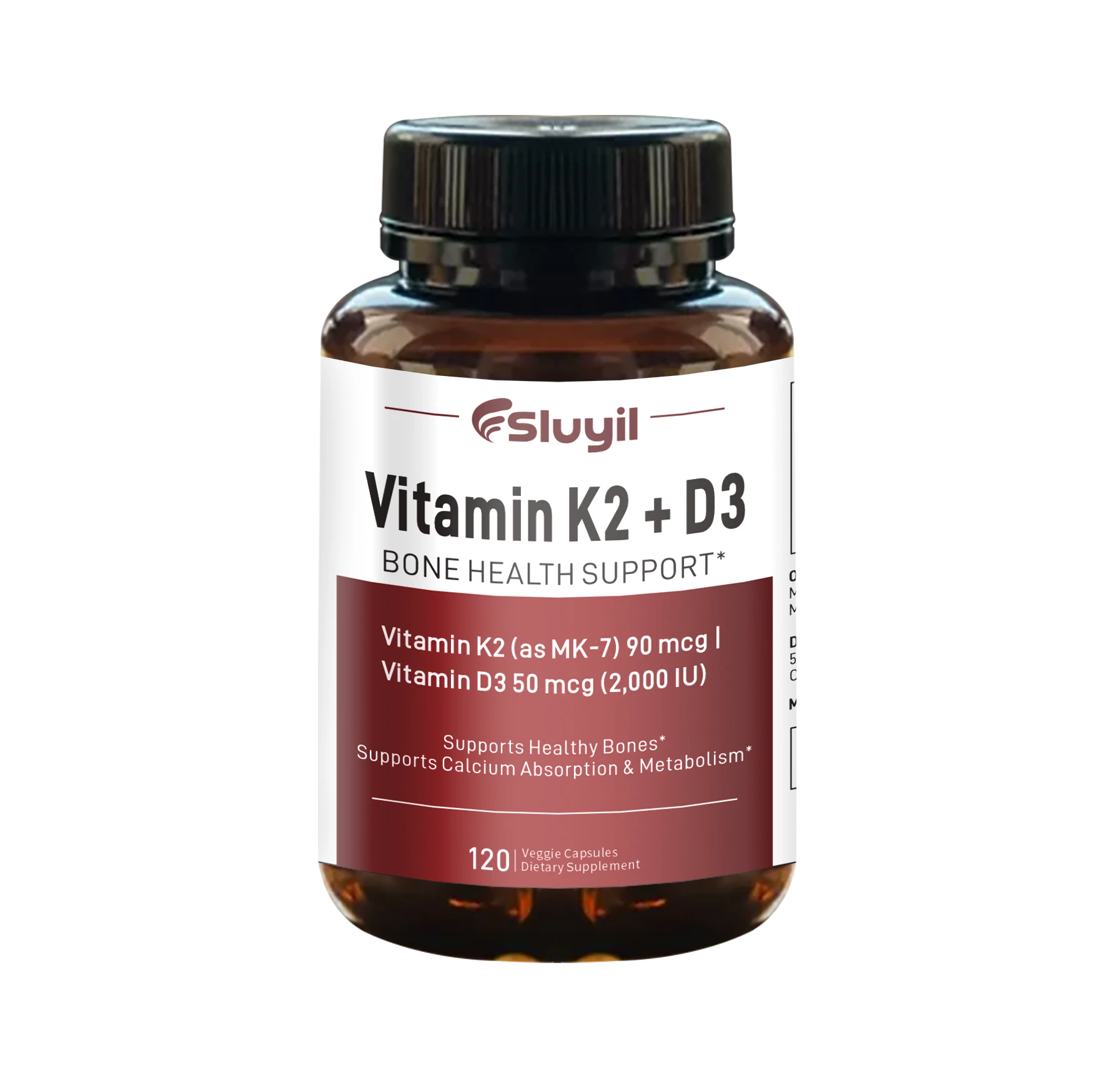
1 vegetable capsule per serving | 120 servings | Vitamin D3 50 mcg (2,000 IU) | Vitamin K2 MK-7 90 mcg | Custom order
This is a D3 and K2 product, for buyers who want a clear daily dose instead of a broad bone�support blend.
The current label shows 50 mcg or 2,000 IU of vitamin D3 and 90 mcg of vitamin K2 as MK�7 in one vegetable capsule.
A bottle gives 120 servings.
The page should keep the D3, K2 and serving facts visible and use the rest of its space to cover form, blend control, shelf�life protection and market�specific label review.
Current Label Facts
| Ingredient |
Amount per serving |
| Vitamin D3 |
50 mcg (2,000 IU) |
| Vitamin K2 as MK-7 |
90 mcg |
| Serving size |
1 vegetable capsule |
| Pack |
120 capsules / 120 servings |
The 120 Count Format
One capsule equals one serving. The bottle count and serving count are both 120. This makes the pack easy to compare. Only if the product image, Supplement Facts, directions and ecommerce fields all use the same bottle count, serving count and capsule count.
A bottle mockup with 60 capsules would change the commercial offer and should have separate metadata.
The long serving count also affects the pack review. Closure choice, induction seal, desiccant decision and bottle headspace should be set for the final commercial pack. A four-month count should not be paired with an untested shelf-life statement.
Keep Both Active Amounts Clear
Keep 50 mcg and 2,000 IU together wherever the amount is shown so buyers do not mistake one unit for a dose. The vitamin K2 is listed separately at 90 mcg. The form is MK-7.
These are low inclusion levels compared with a capsule’s total fill weight. The approved raw materials may use carriers or premixes to support accurate dosing. The master formula and supplier specifications, rather than the front-label numbers alone, determine how much material enters the blend.
MK-7 Stability Is a Project Question
Before quotation, confirm the MK-7 source, assay, carrier system and any handling conditions in the supplier specification. The same applies to the vitamin D3 material. Incoming identity and potency documents need to match the materials named in the finished-product formula.
Lowdose ingredients need a controlled premix and a documented blending sequence.
Packaging should be checked for oxygen and moisture exposure.
The website can list the labeled amounts. The website should not promise potency for a shelf life until the finished formula, package and stability plan support that claim.
A Defined Role in the Product Line
This SKU works as a straightforward D3 and K2 option. It should not repeat the full content used for calcium, collagen, turmeric or joint formulas. Buyers comparing this page need the D3 dose, the MK-7 dose, the capsule count and the practical requirements for a stable finished product.
Claims should remain measured. General nutrient-support wording still needs a destination-market review. Do not turn the formula into a promise to treat osteoporosis, prevent cardiovascular disease, remove arterial calcium or deliver a guaranteed health result.
Custom Order Information
This product has no ready-stock designation in the master list. MOQ, lead time and sample route are quoted after the target market, required count, capsule shell, bottle format and label language are known.
Changing either active amount, the serving count or the delivery form triggers a new formulation and label check. Provide the intended sales market and any restricted ingredient list before artwork starts so the specification and warning language can be reviewed together.
Buyer Questions
Does one bottle contain 120 servings
Yes. I am looking at the design. It shows one vegetable capsule for each serving and a total of 120 servings, in each bottle. Please doublecheck that the final net quantity and the bottle picture still display 120 capsules.
Are 50 mcg and 2000 IU two different D3 amounts
No. They are two units for the same labeled vitamin D3 amount. Keep both units together in the facts table and page copy.
Can the MK-7 level or bottle count be changed
It can be reviewed as a custom project. A change requires a new master formula, label calculation, pack review and destination-market assessment.