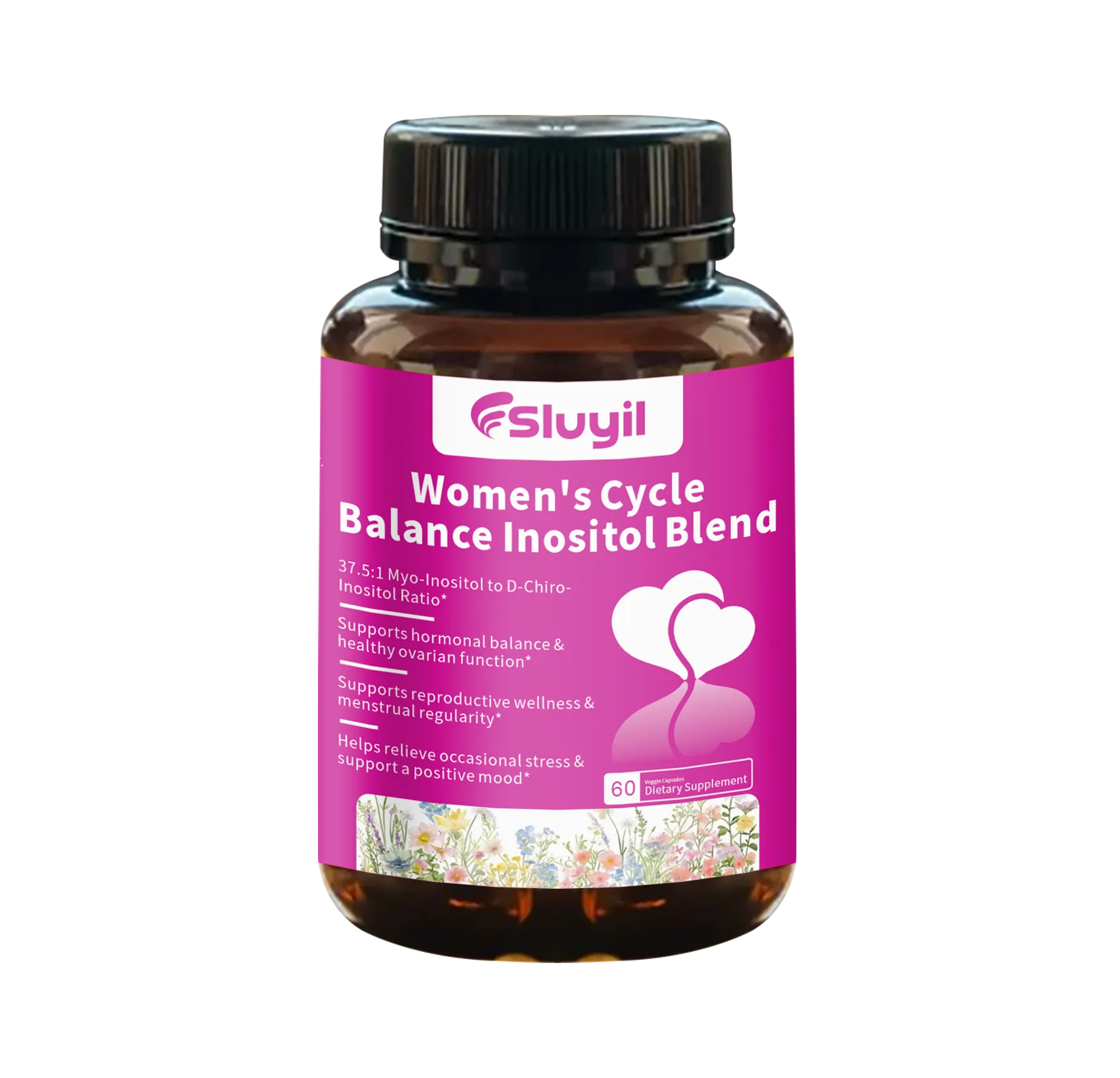
2 vegetable capsules per serving | 30 servings | Inositol 500 mg | D-chiro-inositol 14 mg | CoQ10 100 mg | PQQ 10 mg | Custom order
The buying decision starts with the actual inositol amounts, not the ratio printed in a working name. This capsule uses a much smaller inositol quantity than a gram-level powder, then adds CoQ10, PQQ, astaxanthin and folic acid. It should be sold as a compact women’s wellness complex, not as a capsule substitute for every high-dose inositol program.
The page also needs to keep P026 separate from P046. P026 contains folic acid at 560 mcg DFE. P046 is the active-folate tablet. Mixing those two folate stories would make both pages less accurate.
Current Label Facts
| Ingredient |
Amount per serving |
| Folate as folic acid |
560 mcg DFE |
| Inositol |
500 mg |
| Coenzyme Q10 |
100 mg |
| D-chiro-inositol |
14 mg |
| PQQ |
10 mg |
| Astaxanthin |
4 mg |
| Serving size |
2 vegetable capsules |
| Servings per container |
30 |
Key Product Features
- Two-capsule format gives buyers a compact alternative to an inositol powder.
- CoQ10 at 100 mg is a meaningful secondary ingredient and should remain visible in the product hierarchy.
- PQQ and astaxanthin are low-inclusion actives that require controlled premixing and verified raw-material assays.
- The folate source is folic acid. The page must not call it methylfolate or active folate.
- The formula is custom. MOQ, sample route, packaging and timing follow the approved market and specification.
The Ratio Must Match the Master Formula
A 37.5:1 statement is only useful when the exact amount of each inositol form supports it. The current working record shows inositol 500 mg and D-chiro-inositol 14 mg, but it does not explain whether the 500 mg figure is a combined inositol total or a separate line. R&D should settle that point in the master formula and label calculation before the ratio appears in indexed copy.
Until the calculation is closed, quotations and samples should refer to the individual recorded amounts. Do not round the product to the more familiar 40:1 wording. That would change a defined specification for the sake of a search term.
Capsule Fit and Blend Control
The declared actives add up to more than 600 mg before excipients and processing allowance. Two capsules may be practical, but capsule size cannot be selected from the arithmetic alone. Bulk density, flow, compression tendency and the approved ingredient grades determine the real fill volume.
PQQ, astaxanthin and folate are present at much lower weights than inositol and CoQ10. A documented premix step is needed so the low-dose components are distributed through the batch rather than concentrated in a small part of the blend.
Dose Context Matters
The public page should state 500 mg inositol and 14 mg D-chiro-inositol without implying that research on multi-gram powder servings automatically applies. Buyers who want a gram-level inositol concept may need a powder, more capsules per day or a different formula.
Suitable Consumer Profiles
- Adult women looking for a capsule-format daily wellness formula built around inositol with CoQ10 and antioxidant ingredients.
- Consumers who prefer two capsules to mixing a gram-level powder and who understand that the serving amounts are different.
- Women’s wellness and beauty routines that do not rely on fertility, PCOS, hormone-treatment or pregnancy claims.
- Not automatically suitable for pregnancy, trying to conceive, children or consumers under medical care. Directions and warnings require market-specific review.
Customization Scope
A custom project can revise the inositol amounts, change the ratio, replace folic acid with another approved folate source, adjust the supporting actives or move the concept to powder. Any change needs a new serving-size, stability, capsule-fit and label review.
If a buyer wants a gram-level inositol serving, quote it as a new formulation rather than a label variation. The dosage form and daily serving may need to change.
Packaging and Label Review
The final commercial pack must confirm capsule count, shell material, bottle size, closure, induction seal, desiccant decision and storage statement. CoQ10, PQQ and astaxanthin also make light and oxygen exposure relevant to the package review.
Supplement Facts, Directions, Other Ingredients, warnings and net quantity must be approved as one set. A reference bottle image is not proof that the ratio calculation or final capsule count is closed.
What to Send for a Quote
Send the destination country, intended consumer profile, exact inositol target, preferred folate source, capsule count, packaging format and expected order quantity. HEKONA can then review the ratio calculation, capsule fit, raw-material documents, sample route and quotation.
Buyer Questions
Is this a 40 to 1 inositol formula
No. The working product name states 37.5:1. Do not change it to 40:1. R&D must first reconcile the exact inositol and D-chiro-inositol weights that support the stated ratio.
Does this formula use active folate
No. The current record states 560 mcg DFE as folic acid. P046 is the separate active-folate tablet concept.
Can the inositol amount be increased
Yes, as a new custom review. A higher amount can change the capsule count or make a powder format more practical.
Discuss a Women’s Inositol Capsule Project
Send the target market, intended positioning, confirmed ratio, serving target, packaging and expected quantity. HEKONA will review the formula, sample plan, testing and quotation.